MOS: The Modular Open-Source OS for Servers & Homelabs
▼ Summary
– MOS is a free, modular open-source operating system built on Devuan, designed for homelabs and small servers to manage systems, storage, and containers via a web interface.
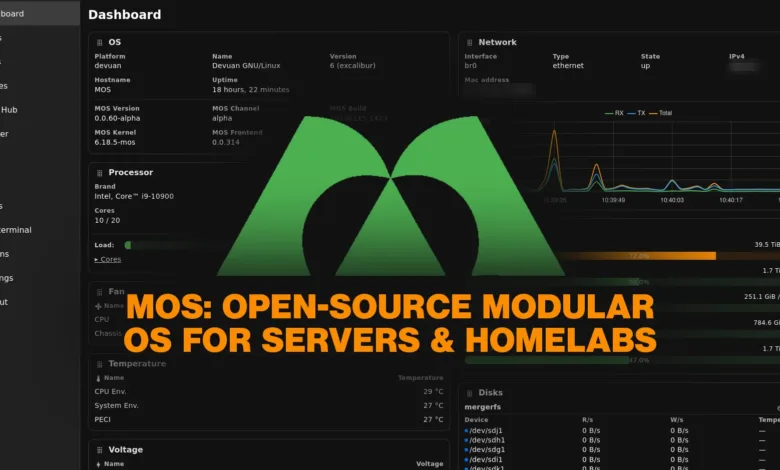
– It provides a comprehensive web dashboard and API for monitoring hardware, managing storage pools, configuring users, and controlling services like Docker and virtual machines.
– The system supports flexible storage through built-in tools like mergerfs and SnapRAID, with extensible capabilities via a central plugin repository for additional drivers and features.
– It integrates service management, logs, notifications, and system settings into a single interface to reduce the need for switching between command-line tools and external dashboards.
– MOS is available for free on GitHub and includes a notification service for real-time alerts within the web UI.
A growing community of homelab enthusiasts and small-scale server administrators is exploring a new open-source operating system designed to streamline infrastructure management. This system, known as MOS, offers a unified web interface and API for handling core server functions like monitoring, storage, and containerization, all built on a Devuan foundation. Its modular architecture aims to simplify complex tasks, making it an attractive option for those seeking an integrated management platform without the overhead of enterprise solutions.
The platform delivers a comprehensive browser-based dashboard. This central hub displays real-time status updates for CPU usage, RAM consumption, storage devices, and network interfaces. Operators can manage storage pools, configure file shares, adjust user permissions, and fine-tune service settings directly from this pane. When enabled, services for Docker containers, LXC containers, and virtual machines are fully integrated into the interface. A live WebSocket connection works alongside the standard REST API, pushing instant notifications and system events to the user for immediate awareness.
Access control is handled through configurable user accounts and roles, with API authentication managed via access tokens. This design intentionally facilitates integration with external automation tools and custom scripts. The interface also provides visibility into system logs, scheduled cron jobs, and service configurations, placing these critical details alongside fundamental system information.
For storage, MOS promotes a flexible and expandable approach. The base system includes tools for pooling multiple disks into a single logical volume using mergerfs and for implementing snapshot-based parity protection via SnapRAID. However, its capabilities are not limited to these defaults. A central plugin repository allows users to install additional storage drivers, significantly extending the system’s versatility. This plugin system also covers hardware support, enabling add-ons for components like GPUs or digital video broadcasting equipment.
A dedicated component, MOS Hub, acts as a catalog for these plugins and for pre-configured application templates. This makes it straightforward for operators to deploy new functionalities and services, tailoring the base operating system to their specific requirements.
Core system services, including the Docker and LXC runtimes, are managed through dedicated configuration panels. Administrators can start or stop the Docker daemon, define container networking rules, and designate storage locations for container data. All system logs and events feed into a notification service, built with Go, which delivers alerts directly within the web interface.
Network configurations, service authentication tokens, and general system preferences are consolidated into a dedicated settings module. The overarching objective is to unify these disparate management elements into a single, coherent interface. This reduces the constant need to switch between terminal commands, standalone dashboards, and various configuration files, creating a more efficient administrative workflow.
The complete MOS operating system is freely available for download and contribution on its public GitHub repository.
(Source: HelpNet Security)