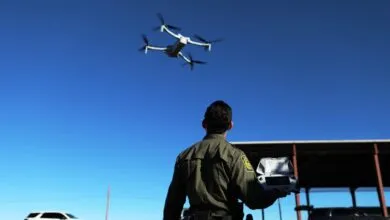
El Paso’s Drone Debacle: A Sign of Air Defense Trouble Ahead

▼ Summary
– A brief airspace closure over El Paso and New Mexico has raised concerns about U.S. anti-drone defenses and public safety.
– The FAA closed the airspace due to concerns over a military laser weapon being used by border officials, which was reportedly aimed at a party balloon.
– Conflicting explanations emerged, with initial claims of targeting cartel drones and later reports of a communication failure between agencies.
– Lawmakers have requested a classified briefing to investigate the incident and prevent future communication breakdowns.
– The weapon used was a LOCUST laser system, reflecting a military shift toward directed energy defenses against proliferating small drones.
The recent and sudden shutdown of airspace around El Paso, Texas, has ignited serious questions about the nation’s readiness to counter drone threats in civilian areas. This event highlights a growing vulnerability as inexpensive unmanned aerial vehicles become more common, posing a significant challenge for authorities tasked with protecting populated regions. Developing safe and effective countermeasures is notoriously difficult, since traditional methods like jamming signals or physically destroying a drone carry substantial risks when used near cities and towns.
Initially, the Federal Aviation Administration announced the closure would last for ten days, but it was lifted after only eight hours. While the administration initially cited concerns about drones operated by Mexican drug cartels, subsequent reporting indicated the real cause was the use of a military-grade anti-drone laser by Customs and Border Protection. The agency was reportedly operating this weapon despite unresolved questions about its potential hazard to commercial aircraft. In a twist, the target of the laser was later identified as a simple party balloon.
“The FAA likely did a very intelligent thing by issuing the Temporary Flight Restriction,” noted cybersecurity expert Tarah Wheeler. She suggested the lengthy initial restriction may have stemmed from a lack of clear communication about how long the laser system would be active, forcing the FAA to err on the side of caution. Officials from the FAA, Department of Defense, and Department of Homeland Security declined to comment on the record about the incident.
Contradictory statements emerged from the White House, where an official stated the FAA administrator made the decision to close the airspace without informing other key agencies. This official insisted that operations against cartel drones were planned and coordinated over months, asserting that “at no point in the process of disabling these cartel drones were civilian aircraft in danger.”
The political fallout was swift. A bipartisan group of federal lawmakers from Texas and New Mexico formally requested a classified briefing from top security and transportation officials. In their letter, they demanded that agencies involved explain their roles, identify the precise communication failures, and outline concrete steps to prevent a repeat of such a disruptive event.
The laser system at the center of the controversy is known as LOCUST, a directed-energy weapon manufactured by defense contractor AeroVironment. It is a 20-kilowatt laser designed specifically to neutralize small drones, representing the kind of technology the military is increasingly interested in for short-range defense. The Army has itself noted that the widespread availability of cheap drones has made systems like lasers and high-powered microwaves a critical new focus for air defense.
This prototype technology was delivered to the U.S. Army as part of a broader initiative to test and develop directed-energy weapons. The El Paso episode, however, serves as a stark real-world test of the complexities involved in deploying such advanced systems near civilian infrastructure, revealing significant gaps in interagency coordination and public safety protocols.
(Source: Wired)