Ancient Mars: A Warm, Wet World, Not a Frozen One
▼ Summary
– A recent study indicates Mars was warm and wet during the Noachian epoch, contrasting with a theory that it was cold and icy.
– The Noachian epoch, from 4.1 to 3.7 billion years ago, occurred during the solar system’s Late Heavy Bombardment of meteorite impacts.
– This era left massive impact basins on Mars, like Hellas and Argyre, which could hold vast volumes of water.
– Despite the bombardment, this period is considered Mars’s most habitable, with abundant evidence of water-carved landforms like river valleys.
– The climatic conditions of this time remain debated between warm/wet and cold/icy scenarios with periodic melting.
The question of whether ancient Mars was a warm, wet world or a frozen, icy one is central to understanding its potential for past life. New research strongly supports the former scenario, suggesting the Red Planet’s early climate was surprisingly temperate and conducive to flowing water. This finding directly challenges an alternative theory of a predominantly cold and icy epoch, reshaping our perspective on Martian habitability during its most promising era for biology.
Mars shares Earth’s approximate age of 4.5 billion years, and scientists divide its geological timeline into distinct epochs. The period in question is the Noachian epoch, spanning from roughly 4.1 to 3.7 billion years ago. This era coincided with a tumultuous phase in solar system history known as the Late Heavy Bombardment, a time of intense meteorite impacts whose scars are visible on planetary bodies throughout our cosmic neighborhood.
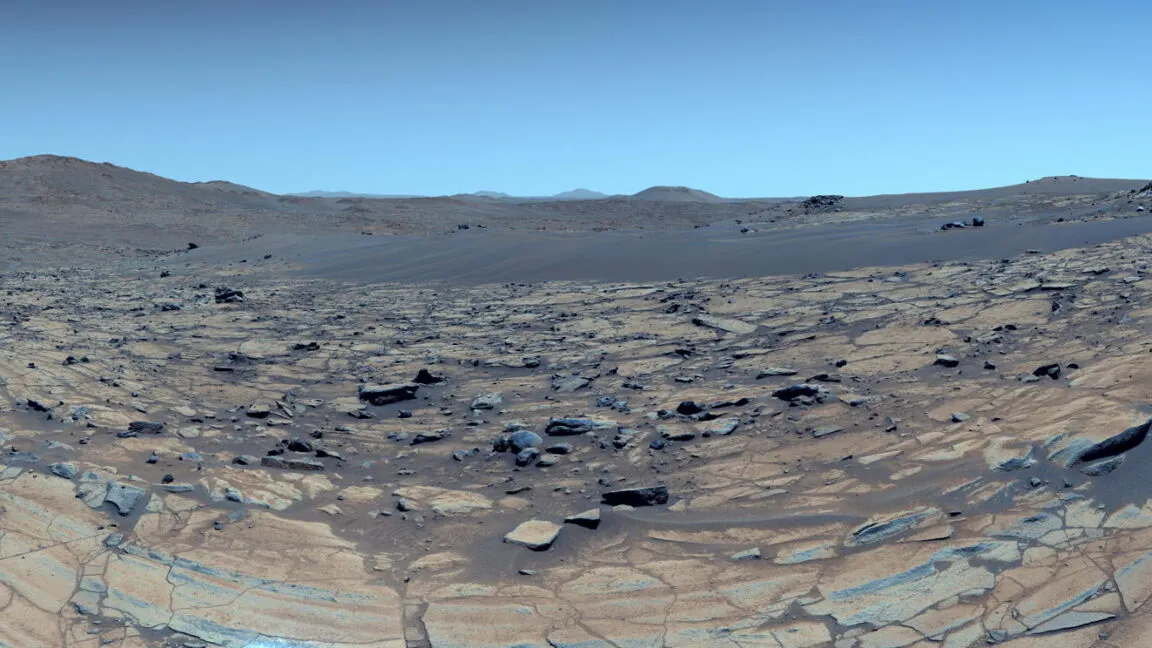
On Mars, two colossal reminders of this violent period are the Hellas and Argyre impact basins. Each stretches over a thousand miles across, with volumes so vast they could each contain all the water in the Mediterranean Sea. Despite this cataclysmic bombardment, the Noachian is paradoxically considered the most likely period for Martian habitability. The geological record from this time is rich with evidence of water activity, including the clear signatures of dried-up river valleys, ancient lake beds, fossilized coastlines, and river deltas.
For years, the prevailing climate conditions of this epoch have been hotly debated. Two competing models have emerged. One proposes a cold, icy Mars, where large volumes of frozen water were only occasionally melted by the heat from massive meteorite strikes or volcanic eruptions. The other argues for a warm and wet climate, largely free of pervasive ice, allowing for persistent liquid water on the surface.
The recent study adds significant weight to the warmer model. By analyzing mineralogical and geological data, researchers find that the patterns of water alteration and erosion are more consistent with a sustained temperate climate than with brief, episodic thaws. This interpretation suggests environments where liquid water was stable for long periods, dramatically improving the conditions under which life could have potentially emerged and thrived billions of years ago on our planetary neighbor.
(Source: Ars Technica)