What If You Orbited Earth at Light Speed?
▼ Summary
– A YouTube simulation visualizes traveling around Earth at light speed, completing the journey in just 0.13 seconds.
– For comparison, a commercial airplane would take about 42 hours, while traveling at the speed of sound would take roughly 32 hours.
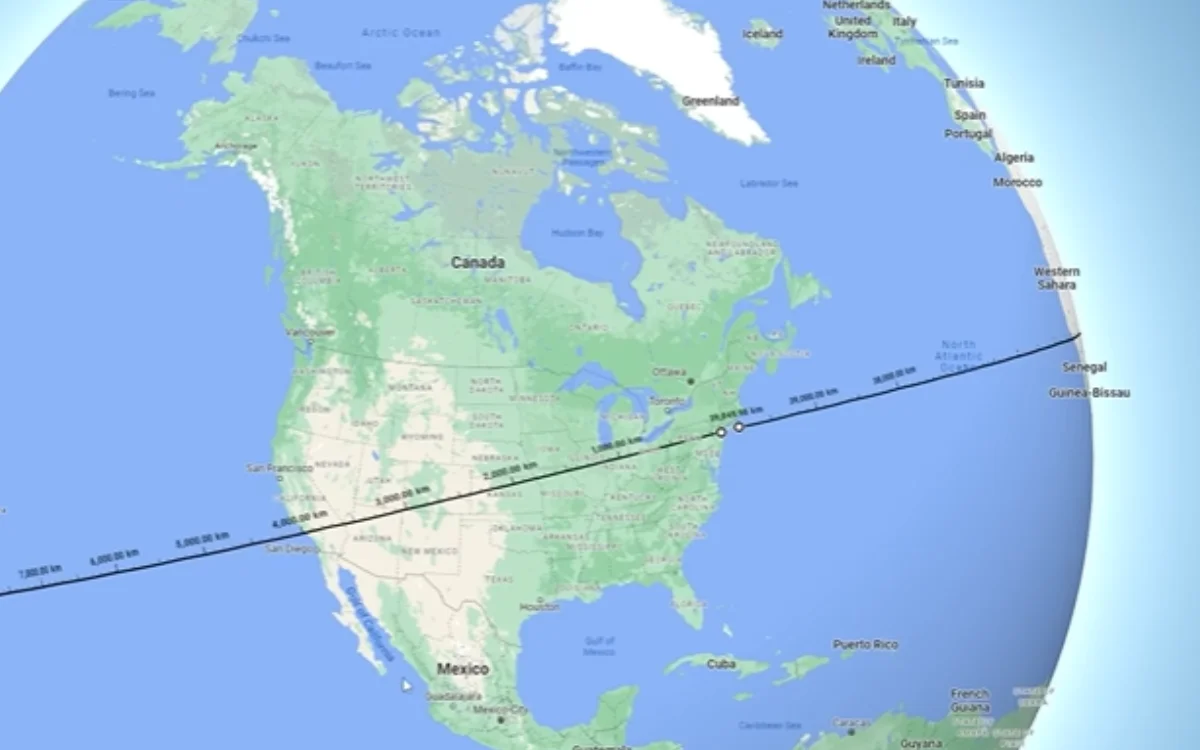
– The simulation’s route starts in New York, crosses the Pacific, passes over Australia and Africa, and returns over the Atlantic.
– No airplane can travel at light speed due to immense practical, safety, and physiological challenges like nausea.
– Hypersonic flights (around 3,800 mph) are the fastest plausible near-future travel, though vastly slower than light speed.
Imagine completing a full lap around our planet in less time than it takes to blink. A recent simulation makes this staggering concept a visual reality, depicting a journey around Earth at the cosmic speed limit: light speed. Clocking in at an astonishing 186,000 miles per second, this velocity allows a theoretical circumnavigation of the globe in a mere 0.13 seconds. The video, created by Airplane Mode, begins its lightning-fast loop above New York City, streaks across the United States and the Pacific Ocean, flashes past Brisbane and Zimbabwe, and returns over the Atlantic, all within eight frames of video.
To fully grasp this incredible speed, it helps to compare it to more familiar benchmarks. A modern commercial jet, traveling between 575 and 600 miles per hour, would require roughly 42 hours to fly around the world. Even the speed of sound, approximately 343 meters per second, is sluggish by comparison; a sonic journey would still take about 32 hours. This stark contrast highlights the mind-bending nature of light’s velocity, making the simulation’s sub-second trip almost impossible to comprehend.
The obvious question arises: will humanity ever experience such travel? The straightforward answer is no; no airplane or spacecraft could ever hope to reach light speed, nor would it be advisable. The physical forces involved would be catastrophic for any known material and any potential passenger, not to mention the profound safety and logistical nightmares. For the foreseeable future, the pinnacle of human speed will likely remain in the realm of hypersonic flight, which aims for velocities around 3,800 miles per hour, incredibly fast by today’s standards, yet a virtual crawl next to light.
While actual light-speed travel remains firmly in the domain of science fiction and theoretical physics, these visual simulations serve a valuable purpose. They allow us to conceptualize the immense scales of our universe and the fundamental laws that govern it. By juxtaposing light with sound and conventional flight, we gain a deeper, more intuitive appreciation for the sheer power of nature’s ultimate speed limit.
(Source: Supercar Blondie)
