NASA Tests Revolutionary Laminar Flow Wing in First Flight
▼ Summary
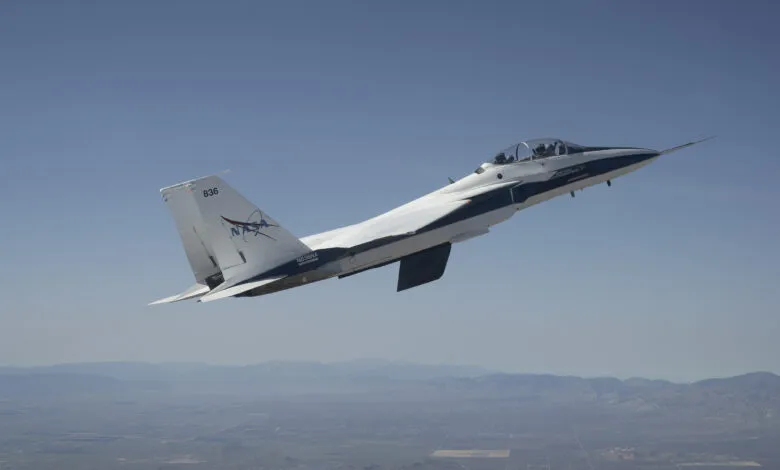
– NASA successfully completed the first flight test of its CATNLF scale-model wing, mounted on an F-15B research jet from Armstrong Flight Research Center.
– The primary goal of the 75-minute test was to confirm the aircraft could maneuver safely with the wing model attached.
– The CATNLF technology is designed to maintain smooth laminar airflow over swept wings, which reduces drag and could lower fuel burn for future aircraft.
– The flight was the first of up to 15 planned tests to collect data across various speeds, altitudes, and flight conditions to validate the design.
– Early results from the flight, using tools like an infrared camera, showed airflow closely matched computer model predictions.
NASA has successfully completed the inaugural flight test of a novel wing design aimed at enhancing laminar airflow, a breakthrough with the potential to significantly cut drag and fuel consumption for next-generation commercial jets. This milestone flight, conducted from the agency’s Armstrong Flight Research Center in California, marks a critical step toward more efficient aviation technologies.
The test involved a specially designed, 40-inch scale-model wing known as the Crossflow Attenuated Natural Laminar Flow (CATNLF) component. Mounted vertically beneath a NASA F-15B research aircraft, the model underwent a 75-minute flight to verify safe handling and performance. Researchers executed a series of maneuvers, including turns and steady holds, at altitudes ranging from 20,000 to 34,000 feet. This initial phase focused on expanding the flight envelope and assessing the aerodynamic behavior of the new design.
Maintaining smooth laminar flow over swept-back wings is a major engineering challenge, as disruptions create drag that increases fuel burn. The CATNLF technology is engineered specifically to minimize these disruptions. By preserving more laminar flow across the wing surface, the design promises substantial reductions in operational costs for airlines. Early data from the flight indicates that the actual airflow closely matched computer model predictions, validating the team’s preparatory work.
During the test, engineers employed an infrared camera and other instruments to gather thermal data and measure the laminar flow characteristics. This information is crucial for confirming the design’s effectiveness and guiding future refinements. The project represents a practical pathway to achieving extensive laminar flow on large aircraft components like wings and tails, which offer the greatest potential for cutting fuel usage.
This first flight is part of a planned series of up to fifteen tests that will examine the wing’s performance across various speeds, altitudes, and flight conditions. It builds upon extensive prior development involving computer simulations, wind tunnel experiments, and ground testing. The research is a collaborative effort under NASA’s Flight Demonstrations and Capabilities project and the Subsonic Vehicle Technologies and Tools project, supported by the Aeronautics Research Mission Directorate.
The successful maiden voyage provides a strong foundation for continued data collection. Future flights will focus on obtaining the research metrics needed to fully validate the CATNLF concept, moving it closer to potential integration into future aircraft designs that prioritize sustainability and economic efficiency.
(Source: NASA)