Tiny RNA Molecule Replicates Itself in Lab
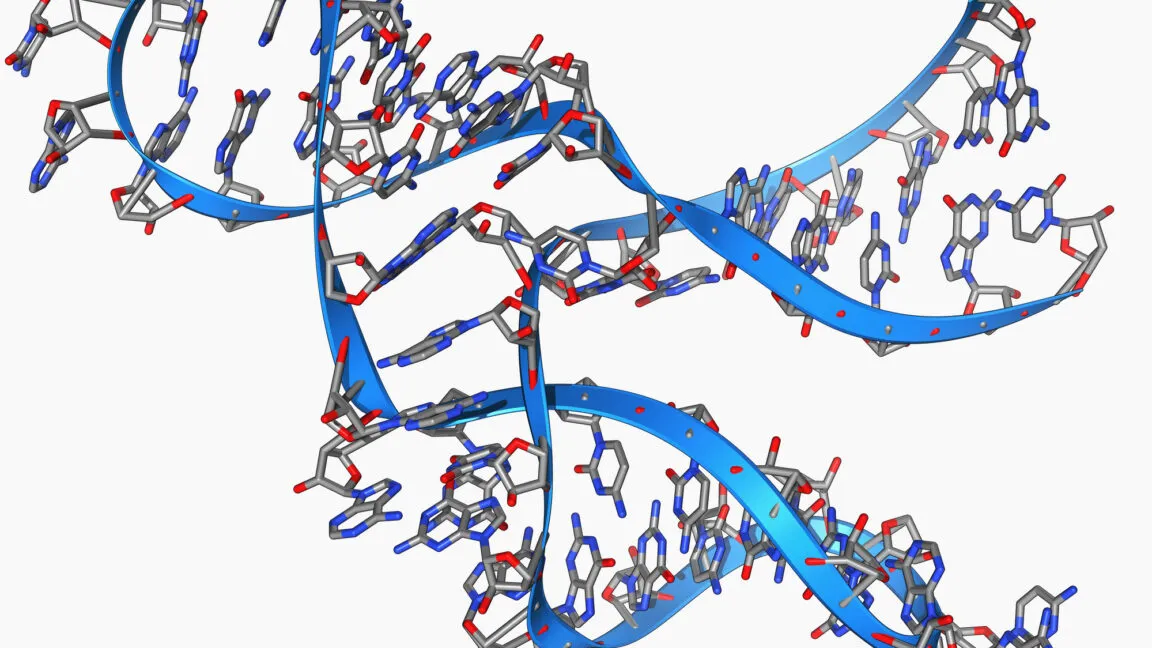
▼ Summary
– A key step in life’s origin is widely thought to be the emergence of a self-replicating RNA molecule, which could handle both heredity and catalysis.
– RNA is unique because it can both carry genetic information and fold into structures that act as catalysts, supporting the “RNA world” hypothesis.
– A major hurdle has been that, while catalytic RNAs exist, none had been found that could perform the crucial act of copying themselves.
– Researchers have now discovered an extremely short RNA strand, only 45 bases long, that is capable of making a copy of itself.
– This new ribozyme functions somewhere between a template-directed ligase, which links RNA strands, and a true polymerase, which adds bases one at a time.
The quest to understand how life began on our planet often circles back to a fundamental idea: the need for a molecule capable of self-replication. A significant breakthrough now brings scientists closer to modeling this pivotal event, as researchers have identified an exceptionally short RNA strand that can copy itself. This discovery provides a tangible model for how early genetic material might have started the chain reaction leading to biological complexity.
For decades, the “RNA world” hypothesis has suggested that RNA, not DNA or proteins, could have served as the cornerstone of primitive life. Unlike DNA, RNA can both store genetic instructions and fold into shapes that accelerate chemical reactions. This dual functionality makes it a compelling candidate for the first self-sustaining biological system. The critical missing piece, however, has been finding an RNA molecule that can perform the ultimate act: creating a faithful copy of its own sequence.
Scientists have cataloged many catalytic RNAs, known as ribozymes, some of which can manipulate other RNA strands. A few function as ligases, joining two RNA pieces together. Others act more like primitive polymerases, adding individual RNA building blocks one by one onto a template strand. The newly discovered ribozyme, a mere 45 nucleotides in length, blurs the line between these categories. It operates in a space between a template-directed ligase and a true polymerase, managing to stitch together complementary fragments to assemble a copy of itself.
This tiny molecule’s ability to self-replicate is not yet perfect or highly efficient, but its existence is profoundly instructive. It demonstrates that a very simple RNA sequence can possess the catalytic toolkit needed for autocatalysis, a process where a molecule makes more of itself. Researchers achieved this by starting with a known ligase ribozyme and, through iterative selection in the lab, evolving it to preferentially link RNA fragments that matched its own sequence. The result is a molecule that can guide the assembly of its mirror image, which in turn can guide the assembly of the original.
The implications for origins-of-life research are substantial. It shows that the leap from passive chemistry to a system with heredity and evolution might not have required an impossibly complex starting molecule. A short, functional RNA sequence could have emerged from prebiotic chemistry and, through self-copying, launched a process of variation and selection. This work doesn’t recreate the exact conditions of early Earth, but it provides a powerful proof of concept. It suggests that the transition from chemistry to biology may have been more accessible than previously imagined, guided by the inherent catalytic potential of RNA.
(Source: Ars Technica)