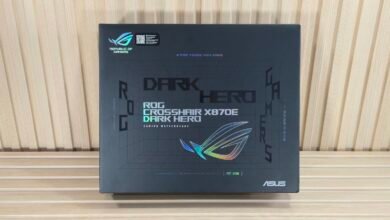
Asus ROG Crosshair X870E Glacial Review: A New Flagship Emerges

▼ Summary
– The Asus ROG Crosshair X870E Glacial is a new, high-end, white E-ATX motherboard for AMD’s AM5 platform, priced at $1,199.99.
– It is exceptionally feature-rich, including seven total M.2 sockets, dual 10 GbE ports, a robust 28-phase VRM, and a large 5-inch LCD screen.
– The board’s design is visually striking but requires removing magnetic shrouds to install a graphics card, which can compromise its clean aesthetic.
– Performance testing shows it delivers solid results in line with other AM5 boards, with gaming performance being good despite slower synthetic benchmarks.
– It includes extensive accessories like Hyper M.2 and DIMM.2 add-in cards for expanded storage and targets enthusiasts with overclocking and DIY-friendly features.
The Asus ROG Crosshair X870E Glacial establishes itself as a new pinnacle for the AM5 platform, blending extreme performance with a striking white aesthetic. This E-ATX motherboard arrives at a premium price point, competing directly with other flagship offerings. It distinguishes itself with an unparalleled set of features, including a massive 5-inch LCD, dual 10 GbE networking, and support for up to seven M.2 drives. Designed for builders who demand the absolute best, the Glacial aims to deliver on every front, from its robust 28-phase power delivery to its extensive connectivity.
Priced at $1,199.99, the board sits in an exclusive tier alongside models like the MSI X870E Godlike X. Its visual design is immediately impressive, dominated by large heatsinks and magnetic shrouds that contribute to a clean, monolithic look. A notable centerpiece is the adjustable 5-inch LCD screen, which can display system information, custom images, or branded animations. However, this focus on aesthetics introduces a minor practical compromise: the striking central shroud must be removed to install a graphics card in the primary PCIe slot, revealing a less polished M.2 heatsink beneath.
Where the Glacial truly excels is in its sheer abundance of high-end hardware. Storage expansion is a key highlight, with a total of seven M.2 sockets available through a combination of onboard slots and included add-in cards. The package contains both a Hyper M.2 card and a DIMM.2 card, with three sockets capable of full PCIe 5.0 x4 speeds. It stands as the only desktop motherboard currently offering two 10 GbE ports, a significant boon for networking-intensive workloads. The rear I/O is exceptionally well-equipped, featuring 14 USB ports that include two 40 Gbps USB4 connections and eight 10 Gbps Type-A ports.
Power delivery is massively overbuilt, utilizing a 28-phase VRM design with 24 phases dedicated to the Vcore. This subsystem employs Infineon 110A MOSFETs, theoretically providing up to 2,640 Amps of current. Such capability ensures stable operation with any AM5 processor, including the highest-core-count models, even under demanding overclocking scenarios. Cooling is addressed with a large heatpipe-connected heatsink for the VRM and multiple thermal solutions for the M.2 drives and chipset.
The board’s performance in testing proved solid and reliable. In productivity benchmarks, results were generally in line with other high-quality AM5 motherboards, showing minor variances above and below average. Gaming performance was excellent in real-world titles, with any synthetic benchmark differences being largely inconsequential for actual gameplay. This indicates the Glacial provides a stable, high-performance foundation without introducing unnecessary overhead or bottlenecks.
Several thoughtful features cater to both enthusiasts and everyday users. The audio solution combines a Realtek ALC4082 codec with an ESS9219 Quad DAC, offering top-tier integrated sound. A proprietary Q-connector near the RAM slots is designed to streamline cable management for compatible Asus all-in-one liquid coolers, though support is currently limited. For overclockers, the board includes physical voltage measurement points, a suite of onboard buttons for controls like Safe Boot and Retry, and reinforced PCIe slots that now use a standard mechanical latch instead of Asus’s previous design.
The accessory package is vast, reflecting the board’s flagship status. Beyond the M.2 expansion cards, it includes multiple fan and RGB splitters, SATA cables, a Wi-Fi antenna, a small fan for memory cooling, and even a novelty bottle opener. This comprehensive kit ensures builders have almost every conceivable cable and adapter on hand.
A few design choices invite scrutiny. The protective plastic film on the chipset heatsinks, buried beneath multiple layers of metal, seems unnecessary and could easily be forgotten. The aesthetic shroud over the PCIe slots, while beautiful, must be removed for functionality, which some may find counterintuitive for a product at this price. Additionally, the highly capable power delivery and dual 10 GbE networking are features that will be underutilized by a significant portion of its potential audience.
Ultimately, the Asus ROG Crosshair X870E Glacial is a technological showcase. It aggregates an extraordinary number of premium features into a single, visually cohesive package. Its performance is excellent, and its expansion capabilities are virtually unmatched. The decision to purchase it hinges on whether your specific needs, such as requiring immense PCIe 5.0 storage, ultra-fast networking, or the absolute strongest power delivery, justify its substantial cost. For the enthusiast seeking no compromises, the Glacial is a compelling, if extravagant, centerpiece for a dream build.
(Source: Tom’s Hardware)