TP-Link Omada SG3218XP-M2 Switch Review: Power & Performance
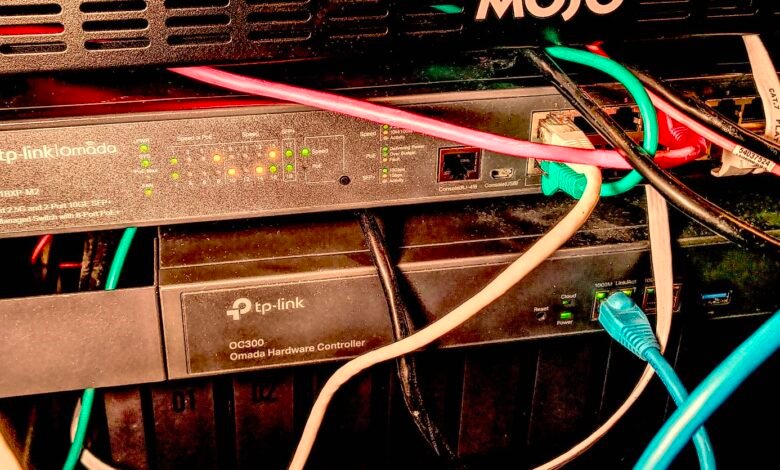
▼ Summary
– The TP-Link Omada SG3218XP-M2 is a managed Layer 3 switch with sixteen 2.5GbE ports (eight PoE+ and eight LAN) and two 10GbE SFP+ ports for a network backbone.
– It is designed to support high-bandwidth devices like Wi-Fi 7 access points and is well-suited for small business deployments with a 240W total PoE budget.
– The switch integrates seamlessly with the Omada ecosystem for centralized cloud, software, or hardware controller management, enabling easy configuration and monitoring.
– Priced around $370 in the US, it offers strong value compared to competitors, though it lacks 10GbE RJ45 ports and higher-wattage PoE++ for some advanced devices.
– The reviewer recommends it for Wi-Fi 7 deployments but suggests also budgeting for a dedicated Omada hardware controller for optimal management.
For businesses and IT professionals looking to upgrade their network infrastructure, the TP-Link Omada SG3218XP-M2 managed switch offers a compelling blend of high-speed connectivity and robust power delivery. This device is engineered to support modern installations that utilize 2.5GbE PoE access points and require a 10GbE backbone, making it a future-proof choice for environments adopting Wi-Fi 7 or deploying high-definition security systems. While it lacks dedicated 10GbE Ethernet ports for connecting to performance NAS units, its overall package delivers significant value for the investment.
Positioned within TP-Link’s Access Pro series, this L3 managed switch provides sixteen 2.5GbE ports. Eight of these supply PoE+ power with a 30W budget per port, while the remaining eight function as standard LAN connections. A total power budget of 240W is available for distribution. Two 10G SFP+ ports facilitate high-speed uplinks to a network core or aggregation switch. For administrators embedded in the Omada ecosystem, integration is seamless, offering centralized cloud management, zero-touch provisioning, and AI-driven monitoring through a dedicated hardware or software controller.
When evaluating cost, the SG3218XP-M2 presents a strong value proposition. Priced around $370 in the United States, it undercuts many competitors offering similar managed Layer 3 functionality. For comparison, Netgear’s offering with 25G capabilities can exceed $4000, while Cisco’s similarly priced Catalyst switch only provides 1GbE ports. A closer alternative is the Ubiquiti Pro Max 16 PoE, but it offers a lower total PoE budget and a different mix of port speeds, which may not be ideal for larger installations. The TP-Link model strikes a careful balance between performance, power, and price.
Build quality is solid, featuring a steel construction that is both rack-mountable and suitable for shelf placement. Its relatively compact and shallow design simplifies installation in space-constrained racks. Cooling is handled by two side-mounted fans, whose speed adjusts dynamically based on system load and PoE output. During testing, operational noise was minimal, contradicting some user reports of a loud fan system. The inclusion of adhesive rubber feet and rack brackets adds to its installation flexibility.
From a user experience standpoint, managing this switch is straightforward, especially within an existing Omada setup. The platform provides three control avenues: a local software controller, a cloud-based service, or a dedicated hardware controller. For reliability, a local hardware controller is recommended, as it can maintain network oversight and send alerts even during an internet outage if paired with an uninterruptible power supply. Configuration profiles can be deployed en masse across all Omada devices, yet the system allows for granular adjustments when specific needs arise.
In final assessment, the Omada SG3218XP-M2 is an excellent choice for those modernizing their network. It is particularly well-suited for deployments leveraging Wi-Fi 7 access points, as its 2.5GbE PoE+ ports prevent the network backhaul from becoming a bottleneck. The ability to connect to a 10GbE backbone ensures ample bandwidth for aggregated traffic. However, it is not the tool for every job. Organizations requiring 10GbE PoE++ for the most demanding access points or devices will need to look at more expensive, higher-tier switches. For the majority of small to mid-sized business deployments seeking a managed, high-performance switching solution, this model delivers powerful features at a very reasonable cost.
(Source: TechRadar)

