Lead to Gold: How Physicists Achieved Alchemy

▼ Summary
– The fundamental human drive to understand the world connects modern science with historical alchemy, though their specific goals differ.
– While ancient alchemists sought but failed to achieve chrysopoeia (the artificial creation of gold), modern scientists can theoretically accomplish it using a particle accelerator, energy, and funding.
– Physicists at CERN’s Large Hadron Collider successfully created gold nuclei during the ALICE experiment, which collides heavy particles to simulate post-Big Bang conditions.
– The experiment produced 86 billion gold nuclei, but this amounted to only trillionths of a gram, an utterly negligible and unusable quantity.
– The created gold atoms were extremely unstable, decaying within microseconds, making their production more of a scientific curiosity than a practical achievement.
The age-old dream of turning base metals into precious gold, a pursuit known as chrysopoeia, has captivated human imagination for centuries. Modern physics has transformed this mystical quest into a tangible, though not yet practical, reality. Using immense technological power, scientists have successfully created gold atoms, achieving the symbolic goal of the ancient alchemists through the precise application of nuclear physics rather than mystical formulas.
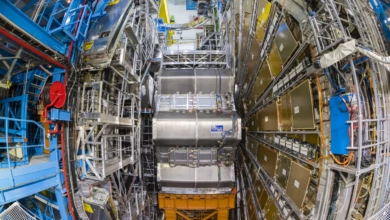
This modern transmutation was accomplished at CERN’s Large Hadron Collider during the ALICE experiment. Researchers were not seeking gold; their primary goal was to study the quark-gluon plasma, a state of matter believed to have existed just after the Big Bang. To do this, they accelerated lead ions to near light-speed and smashed them together in powerful collisions. Within the debris of these high-energy impacts, the experiment detected the creation of approximately 86 billion nuclei of gold.
While that number sounds astronomical, the actual mass of gold produced is vanishingly small. It amounts to mere trillionths of a gram, a quantity so insignificant it is invisible to the naked eye and undetectable by ordinary means. Specialized equipment, like zero-degree calorimeters, was required to measure the subtle shifts in protons and neutrons that confirmed the gold’s fleeting existence. Furthermore, the gold atoms created were highly unstable isotopes. They decayed into other particles in less than a microsecond, making their creation a fascinating scientific footnote rather than a viable production method.
The process demands a particle accelerator, colossal amounts of energy, and enormous financial resources, rendering it entirely impractical for creating valuable material. The energy and cost required to produce a single, stable gold atom would far exceed the market value of the resulting metal. Thus, while physicists have technically achieved the alchemist’s dream, they have also demonstrated why it remains a scientific curiosity rather than an economic venture. The true value lies not in the gold produced, but in the profound insights gained into the fundamental forces that shape our universe.
(Source: BGR)