StationPC PocketCloud Review: A Portable NAS Hampered by High M.2 SSD Costs
▼ Summary
– The StationPC PocketCloud is a portable NAS device designed to bridge field data collection and secure backup, functioning as both an external drive and a full network-attached storage system.
– It features a battery-powered, aluminum-bodied unit with an internal M.2 SSD slot and a dock accessory that adds a second SSD slot, a 2.5GbE LAN port, and charging capabilities.
– A key strength is its software, which enables automated, multi-tiered backup strategies to copy data from the device to cloud services, remote NAS systems, or the dock’s secondary drive.
– The review notes significant drawbacks, including performance limited by a single PCIe lane, a lack of robust security like two-factor authentication, and physical access vulnerability due to exFAT formatting.
– The overall cost is heightened by the need to purchase separate M.2 SSDs, whose prices have risen significantly since the product’s launch, impacting its value proposition.
For professionals who collect large amounts of data in the field, securing that information quickly and reliably is a constant challenge. The StationPC PocketCloud Portable NAS aims to solve this by acting as a bridge between data collection and final storage, functioning as a full network-attached storage device you can take anywhere. This unique gadget runs on its own operating system with up to six hours of battery life, housing an M.2 SSD slot for up to 8TB of capacity. It connects via USB, Wi-Fi, or Bluetooth, and an optional Dock adds a 2.5GbE LAN port and a second M.2 slot. Its clever software allows for automated, multi-tiered backups to cloud services or remote NAS devices, addressing the common pitfall of forgotten backups and single-source data vulnerability.
Pricing and overall value present a mixed picture. The base PocketCloud unit starts around $255, with the highly recommended Dock raising the total to roughly $342. It’s crucial to remember this is before the cost of the required M.2 NVMe drives, whose prices have risen significantly since the product’s launch. Compared to simple M.2 enclosures, the PocketCloud seems expensive, but it’s an unfair comparison given its sophisticated NAS functionality. While not cheap, its unique proposition offers solid value for solving a specific problem.
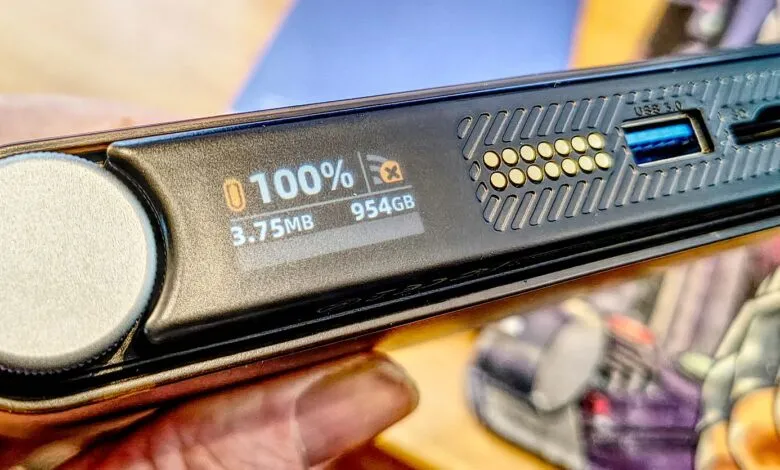
The device sports a durable aluminium shell with rounded edges. A front dial controls a small menu display, and ports include USB-A, USB-C, and an SD card reader. Inside, two user-replaceable 18650 batteries and a single M.2 2280 slot are found. The design’s major limitation is its reliance on a single drive, creating a potential point of failure. The accompanying Dock, almost a necessity, mirrors the unit by adding a second M.2 slot and that crucial 2.5GbE Ethernet connection, dramatically expanding the system’s capabilities.
Powering the device is a Rockchip RK3568B2 processor, a 2021-era chip built on a 22nm process. It features four Cortex-A55 efficiency cores, which aid battery life, and supports a single PCIe lane to the SSD. This hardware choice likely balanced performance, power, and cost, but it results in a bandwidth cap that influences real-world speed.
User experience is defined by flexible software with notable security gaps. The StationCloud apps for PC, Mac, Android, and iOS enable powerful automated backup chains between the PocketCloud, Dock, and cloud services. You can also access files remotely via a web portal. However, the security model has weaknesses. While remote access requires login credentials, physical access to the device is a different story. Anyone can rebind it to a new account using the dial or access files directly via USB mode, as the drives use the unencrypted exFAT file system. For business users, this is a significant concern.
Performance is entirely dependent on the connection method. The fastest option is a direct USB-C link, which in testing delivered excellent speeds of just over 1,000 MB/s, effectively maxing out the single PCIe lane. Network transfers are slower, with the 2.5GbE connection topping out around 275 MB/s, and Wi-Fi being the slowest option. For moving terabytes of data regularly, the speeds may feel limiting, but they represent a conscious trade-off for portability and battery life.
In final assessment, the PocketCloud is a brilliantly conceived tool hampered by some practical realities. It excels at creating automated, multi-destination backups on the go, filling a genuine market gap. The single-drive design and performance ceiling are understandable compromises, but the lack of robust physical security is a more serious drawback. Furthermore, the current high cost of M.2 SSDs adds a substantial premium to the overall system. It’s a highly effective solution for mobile professionals who prioritize redundant backups, provided they are aware of its security limitations and have budgeted for the necessary storage drives.
Consider the StationPC PocketCloud if you need to establish automated backups while traveling and have spare M.2 drives to offset costs. Look elsewhere if you regularly need to secure terabytes of data quickly or require strong hardware encryption for sensitive information.
(Source: TechRadar)