Japan’s 5-Ton Satellite Lost After Rocket Launch Mishap

▼ Summary
– The article discusses an unexpected failure of Japan’s H3 rocket during its eighth launch in December 2025, which was carrying the Michibiki 5 navigation satellite.
– The failure occurred during the payload fairing separation, releasing debris and causing the satellite to wobble, a type of malfunction not anticipated by engineers.
– The Japan Aerospace Exploration Agency (JAXA) has conducted a detailed investigation and publicly released extensive data, including a fault tree analysis and sensor graphs.
– This public release of detailed failure information is notable, as most launch providers typically do not share such comprehensive data after a malfunction.
– The incident represents a novel failure mode, differing from more common issues like engine or guidance problems, and surprised even experienced space industry observers.
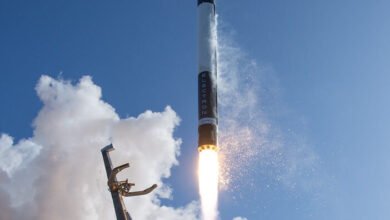
In the high-stakes world of spaceflight, where success hinges on countless variables, a recent Japanese rocket launch encountered a baffling and novel failure. The H3 rocket, Japan’s flagship medium-to-heavy lift vehicle, successfully launched on December 22nd from Tanegashima Island, carrying the critical five-ton Michibiki 5 navigation satellite. The mission aimed to deliver the spacecraft to a high orbit over 20,000 miles above Earth. For nearly four minutes, the flight proceeded flawlessly, until the moment the rocket was to shed its protective payload fairing.
That routine procedure triggered a catastrophic chain of events. Onboard camera footage revealed a sudden shower of debris enveloping the satellite, which immediately began to wobble and tilt uncontrollably. Concurrently, sensors detected sharp, unexpected accelerations at the interface where the spacecraft was mounted to the rocket. The Michibiki 5 satellite was lost, representing a significant setback for Japan’s space navigation capabilities.
The Japan Aerospace Exploration Agency (JAXA) has since conducted a thorough investigation, briefing government officials and releasing a remarkably detailed public presentation. This transparency is unusual in an industry where launch failures are often shrouded in secrecy. The agency’s report includes intricate fault tree analyses, sensor data graphs, and technical illustrations, providing a rare glimpse into post-mishap diagnostics.
While some technical nuances remain challenging for outsiders to fully decipher, the core issue is evident. The failure occurred precisely during the payload fairing separation sequence, a phase engineers had not identified as a critical risk. This incident underscores a sobering reality of rocket science: despite rigorous testing and simulation, missions can be undone by unforeseen and seemingly minor anomalies. The H3’s eighth flight has added a new, unexpected chapter to the long catalog of launch vehicle malfunctions, reminding everyone in the space business that imagination about potential failures must always stretch further.
(Source: Ars Technica)