V-Color Manta XFinity 128GB DDR5-6400 Review: Dual-Module Powerhouse
▼ Summary
– The V-Color Manta XFinity RGB DDR5-6400 C32 is a high-performance 64GB-per-module RAM kit that enables 128GB capacity in dual-slot motherboards, transforming compact systems.
– It features a sleek aluminum heat spreader for cooling and aesthetics, stands 43mm tall for broad compatibility, and uses third-party RGB software for lighting control.
– The kit utilizes SK hynix memory chips, supports AMD EXPO for a DDR5-6400 profile, and outperformed a G.Skill competitor on an Intel test system.
– On an AMD test system, the kit was outperformed by the G.Skill DDR5-6000 due to the Ryzen 9 9900X’s inability to run DDR5-6400 at an optimal 1:1 clock ratio.
– While offering excellent performance and capacity, the kit is currently affected by a global shortage, making it expensive and hard to find at its original price.
For builders of compact, high-performance systems, the V-Color Manta XFinity RGB DDR5-6400 C32 kit represents a significant leap forward. By offering a massive 128GB of capacity in just two modules, it directly addresses a long-standing limitation for small-form-factor enthusiasts. This dual-module powerhouse transforms mini-ITX and microATX motherboards into serious workstations, capable of tackling intensive creative workloads, complex simulations, and heavy multitasking without compromise.
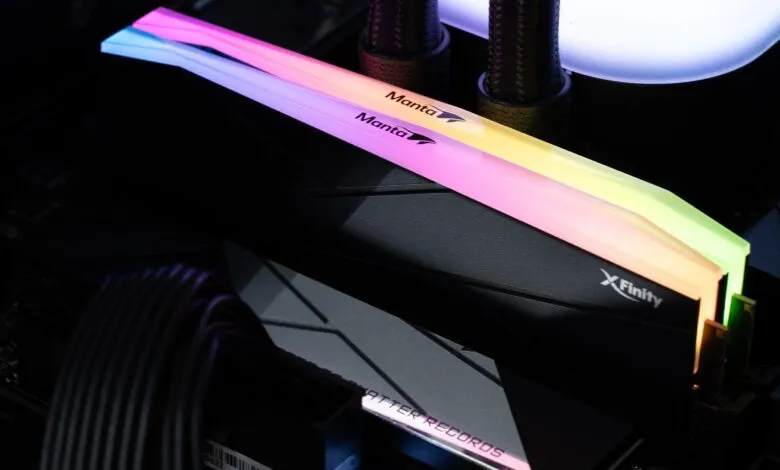
Visually, the modules are sleek and purposeful. They feature a 1.5mm-thick aluminum heat spreader with a geometric groove design that aids in heat dissipation while maintaining a modern aesthetic. The modules stand 43mm tall, which should fit in most builds, though clearance with oversized CPU air coolers is worth verifying. A semi-transparent light bar houses 16 LEDs for RGB lighting, which can be controlled through major motherboard ecosystems like Asus Aura Sync and MSI Mystic Light Sync, as V-Color does not bundle proprietary software.
Underneath the spreaders, the 64GB modules utilize a dual-rank design with integrated circuits on both sides of the PCB. They are built with SK hynix M-die memory chips and a Richtek power management IC. Out of the box, the kit runs at a baseline DDR5-4800 speed. Its single AMD EXPO profile pushes it to its rated DDR5-6400 with timings of 32-45-45-96 at 1.4V. Notably, the kit lacks Intel XMP support, focusing solely on the AMD platform.
In performance testing on an Intel Core Ultra 9 285K platform, the V-Color kit’s higher frequency allowed it to consistently, though modestly, outpace a comparable G.Skill DDR5-6000 kit in both application and gaming benchmarks. The story shifted on AMD’s platform using a Ryzen 9 9900X. Here, the G.Skill kit actually performed better because the specific Ryzen processor could not maintain a 1:1 ratio between the memory controller and clock at DDR5-6400, highlighting that not every AMD CPU can fully utilize these high speeds.
Overclocking headroom proved minimal, which is typical for high-capacity kits using tightly binned memory. A slight voltage bump achieved DDR5-6466, and only minor timing adjustments were possible. This isn’t necessarily a drawback, as it means the modules are already performing near their optimized limits straight from the factory.
Ultimately, the Manta XFinity kit delivers an excellent blend of tremendous capacity and strong performance for productivity and demanding applications. Its major challenge is availability and cost. Originally priced at a premium $479.99, it has become even more expensive and scarce due to industry-wide memory shortages. At the time of writing, only a vastly more expensive DDR5-6800 variant is listed. For those needing extreme capacity in a compact build, this kit is a compelling engineering achievement, but waiting for the DDR5-6400 model to return at a sensible price is the most prudent approach.
(Source: Tom’s Hardware)