Pimax Crystal Super Review: Is It Worth the Hype?
▼ Summary
– The Pimax Crystal Super offers exceptional visual immersion with a high-resolution display and a wide 140-degree field of view, making it ideal for simulation games.
– Its major drawback is significant physical weight, which causes discomfort and limits its use for active, fast-paced games.
– The headset demands a very high-end PC (at least an RTX 4080 is recommended) to utilize its powerful specs, making it a costly overall investment.
– Setup requires using Pimax’s proprietary software, which adds an extra step but is generally reliable and easy to navigate once configured.
– It is a premium, niche product best suited for sim enthusiasts with a high budget, rather than a general-use VR headset.
For simulation enthusiasts with deep pockets, the Pimax Crystal Super delivers a stunning visual experience that sets a new benchmark for immersion. However, its substantial physical weight and very high system requirements create significant barriers, making it a niche product that is difficult to recommend for the average VR user or anyone without a top-tier gaming PC.
This headset demands serious hardware. While Pimax suggests a minimum of an RTX 2070, the reality is that you’ll want at least an RTX 4080 or equivalent to truly unlock the potential of its high-resolution displays. Spending nearly two thousand dollars on the headset alone makes little sense without a powerful computer to drive it. Potential buyers with mid-range systems would be better served by a less demanding VR setup. The experience also relies on Pimax’s own software suite, which acts as a necessary driver hub. It’s generally straightforward to navigate, but it is an extra layer of configuration, especially for titles like Microsoft Flight Simulator.
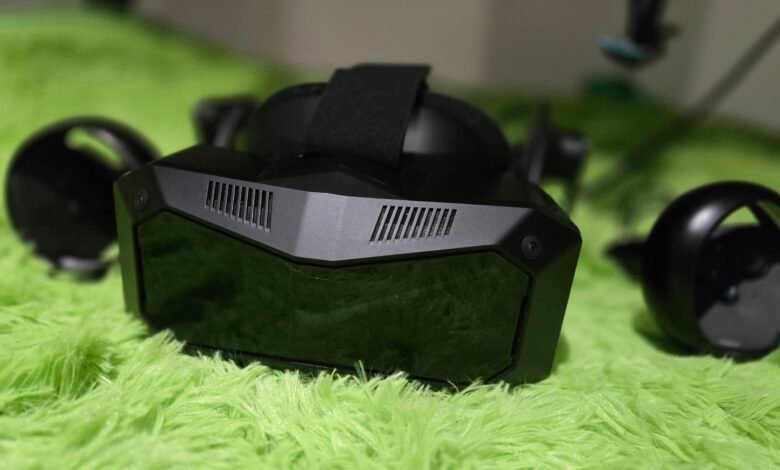
Immediately upon unboxing, the headset’s size and heft are apparent. The construction feels robust, with a sturdy plastic chassis and thick cables, but it is undeniably one of the heaviest modern headsets available. Adding the optional speaker module increases the weight further. Surprisingly, the comfort of the fit is quite good thanks to an adjustable head strap system with a dial for tightening and plush facial interfaces. The issue isn’t discomfort from pressure, but the simple, unavoidable strain of balancing over a kilogram of equipment on your forehead and neck.
This weight becomes a major drawback in active games. During sessions of Beat Saber, the strain built up quickly, making my neck ache after just a few songs. The headset fares much better in seated experiences. In racing sims or flight simulators, where you are largely stationary, I could play for about an hour before the weight became a significant distraction, allowing the impressive technology to take center stage.
And that technology is where the Crystal Super genuinely excels. The visual fidelity is breathtaking. The combination of ultra-high resolution and a 140-degree field of view creates a level of immersion that is hard to overstate. Soaring over digital landscapes in a flight simulator or focusing on the track ahead in a race feels profoundly convincing, aided by a smooth 90Hz refresh rate. Minor visual artifacts like slight screen-door effect or chromatic aberration are noticeable only in static moments like loading screens, not during active gameplay. The one visual shortcoming is the lack of true blacks, which can make dark scenes feel slightly washed out.
The optional detachable speakers significantly enhance the experience. In a game like Half-Life: Alyx, the fusion of expansive visuals and precise spatial audio created moments of genuine presence, I once instinctively reached out to touch a virtual window. Beyond the visuals, the headset has proven reliable. After the initial setup, it operates consistently. I encountered a single controller tracking issue that was resolved with a simple restart, and it has never crashed or malfunctioned during gameplay.
Ultimately, the Pimax Crystal Super is a powerhouse headset with an equally powerful price tag. It achieves visual wonders that can trick your brain in new ways, but its physical burden forces you to limit play sessions. It represents a major investment for a device you cannot use for extended periods. If you have a supreme PC, a strong neck, and a primary interest in seated simulation games, it offers a peerless visual experience. For everyone else, the compromises are simply too great to justify the cost.
(Source: PC Gamer)


