XR 2025: Key Trends Shaping 2026
▼ Summary
– Meta is aggressively cutting its Reality Labs division and shifting its XR strategy away from VR and the metaverse, focusing instead on smart glasses and AI as a path toward future AR glasses.
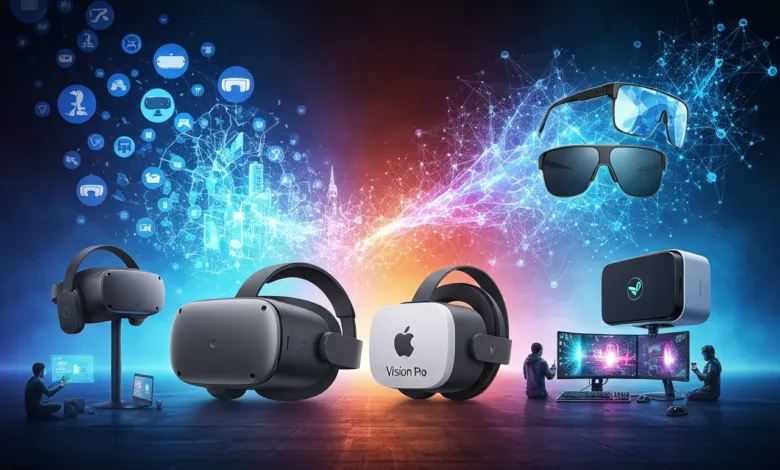
– 2025 saw major XR hardware launches, including Google’s Android XR platform, Samsung’s Galaxy XR headset, an Apple Vision Pro refresh, and Valve’s new standalone Steam Frame headset.
– Valve announced its Steam Frame VR headset but confirmed it has no new first-party VR game in development, leaving a content gap for the PC VR platform.
– The VR gaming market shifted dramatically toward free-to-play multiplayer titles, causing financial struggles for veteran studios focused on premium single-player experiences.
– Apple worked on fixes for its first-generation Vision Pro in 2025, and industry observers expect continued software improvements while awaiting a future, more compact hardware redesign.
The extended reality landscape experienced a seismic shift in 2025, setting the stage for a year of intense realignment in 2026. Major strategic pivots from industry giants, a flurry of new hardware announcements, and a dramatic change in consumer preferences have collectively redrawn the map for virtual, augmented, and mixed reality technologies. This period of transition promises to redefine competitive dynamics and reshape what users can expect from immersive experiences in the near future.
Meta’s dramatic strategic retreat from its aggressive metaverse and VR content investments stands as the year’s most consequential development. The company’s Reality Labs division faced significant cuts, with internal studios shuttered and projects like Horizon Workrooms discontinued. This move signals a clear departure from building a forced digital universe, refocusing instead on a more natural evolution of its headset platform and a sharper emphasis on smart glasses. The ultimate ambition remains full augmented reality eyewear, as previewed by prototypes like Orion, with the Ray-Ban Display glasses and associated ‘neural band’ technology representing critical steps on that path. Meta’s pullback creates a potential power vacuum, possibly allowing other players to assume a more influential role in steering the industry’s direction after years of its dominance.
Hardware innovation reached a fever pitch, making 2025 arguably the most active year for new product reveals in recent memory. The launch of Android XR, Google’s direct answer to Apple’s VisionOS, fundamentally altered the competitive operating system landscape. Samsung’s Galaxy XR headset, built on this platform, emerged as a direct challenger to the Vision Pro. Apple itself refined its first-generation device with a new processor and a crucially improved headstrap. In a surprise to many, Valve announced the Steam Frame, its first fully standalone headset designed to seamlessly integrate with a user’s existing Steam game library. Concurrently, the smart glasses arena heated up considerably, with companies like XREAL and VITURE securing massive funding rounds and advancing their AR-capable devices, applying pressure on Meta to accelerate its own AR glasses roadmap.
The content ecosystem within VR underwent a painful but decisive transformation. A wave of veteran studios known for premium single-player experiences faced severe financial strain or closure, including Cloudhead Games and nDreams. This struggle coincided with the meteoric rise of free-to-play multiplayer titles like Gorilla Tag and Animal Company, which captured a younger audience and dominated platform charts. This market shift strongly indicates that the bulk of active VR users now prioritize social, multiplayer experiences over traditional narrative-driven games. Studios that survive will likely pivot toward free-to-play models or “VR optional” projects, reflecting this new market reality.
Valve’s Steam Frame headset arrived without the expected flagship game, a notable omission that left many questioning its market impact. While the device offers neat innovations like eye-tracked wireless streaming, it may ultimately cater to a niche of dedicated PC VR enthusiasts rather than sparking a mainstream revolution. Meanwhile, Apple spent the year addressing the well-documented first-generation shortcomings of the Vision Pro. The company’s continued investment in VisionOS may prove more significant for the industry in the long run than any immediate hardware iteration, as the platform establishes foundational frameworks for spatial computing.
Adding a dose of unpredictability, Nintendo announced a surprising revival of its infamous Virtual Boy console as an accessory for the Switch platform. While seemingly a nostalgic curiosity, it reintroduces the concept of dedicated immersive hardware to a massive, mainstream gaming audience. Looking ahead, companies like HTC and Snap represent major wildcards. HTC, having sold much of its XR talent to Google, now meanders between VR and smart glasses, potentially positioned to fill the space Meta is vacating. Snap, framing its future on consumer AR, plans to launch its first glasses and leverage its vast community of Snapchat AR developers, betting on a social-first approach to find success.
The collective events of 2025 have undeniably set a new trajectory. The coming year will reveal how the industry adapts to Meta’s recalibration, whether new hardware platforms gain traction, and how developers navigate the clear consumer shift toward connected experiences. The stage is set for a period of heightened competition and innovation that will test every company’s vision for the future of extended reality.
(Source: RoadToVR)