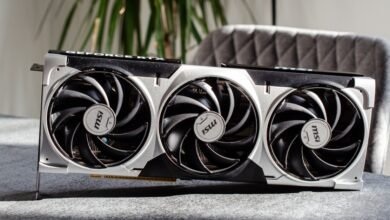
Asus Denies Discontinuing Nvidia’s Most Affordable 4K GPU

▼ Summary
– Asus has issued a statement denying it has discontinued the RTX 5070 Ti and 16GB RTX 5060 Ti, attributing limited availability to a memory shortage affecting production and restocking.
– Despite official denials, leakers claim Nvidia is limiting or phasing out higher-end RTX 50-series GPUs with more VRAM, like the 5090, 5080, and 5070 Ti, making them hard to find at original prices.
– A reported global memory shortage, driven by AI data center demand, is severely constraining the supply of VRAM, which is critical for high-resolution gaming GPUs.
– There are concerns Nvidia may be prioritizing the production of GPUs with only 8GB of VRAM, potentially reducing availability of models like the 16GB RTX 5060 Ti and RTX 5070 Ti.
– The overall GPU supply shortage is expected to drive prices even higher, with AMD noting efforts to keep costs down on its competing Radeon RX 9070 XT.
The availability of affordable 4K gaming graphics cards is facing significant pressure, with conflicting reports about the future of key Nvidia models. Asus has officially denied claims that it is discontinuing the GeForce RTX 5070 Ti and the 16GB variant of the RTX 5060 Ti. The company attributes current stock shortages to a widespread memory supply crunch, which is disrupting production and restocking schedules globally. They emphasize that limited availability in some regions should not be mistaken for a product retirement.
However, this corporate statement clashes with persistent rumors from industry insiders. Several reliable sources suggest that Nvidia itself is limiting the production of higher-end RTX 50-series cards with larger VRAM capacities. A prominent leaker, Moore’s Law Is Dead, has stated that models like the RTX 5090, 5080, and 5070 Ti are being phased out, making them exceedingly difficult to find at their original retail prices. This situation is expected to become clearer as market pricing adjusts in the coming weeks.
The original concern stemmed from a report by the Hardware Unboxed YouTube channel, which claimed Asus had placed its RTX 5070 Ti add-in-cards on end-of-life status. This would mean existing inventory is the last to be sold. Asus responded by stating it could not confirm that news and noted that no U.S. spokesperson would discuss Nvidia’s broader distribution strategy. This marks a significant moment, as it’s the first indication from a board partner about critically dwindling stock for these GPUs.
The root cause appears to be a major shift in the memory industry. Leading manufacturers like Samsung, SK Hynix, and Micron are now heavily focused on producing high-bandwidth memory for AI data centers. This pivot has created severe shortages not only in standard RAM but also in SSD storage and, crucially, the VRAM (video random access memory) essential for rendering high-resolution graphics. Cards designed for 4K gaming, which require substantial VRAM, are particularly vulnerable to these supply constraints.
The impact may extend beyond the 5070 Ti. Reports indicate that Nvidia could be prioritizing GPUs with lower VRAM counts within its product stack. For instance, while the RTX 5060 Ti comes in both 8GB and 16GB versions, the company may focus its limited memory supply on producing the 8GB model. This would potentially sideline the more capable 16GB variant. Meanwhile, the highest-end models like the RTX 5080 and 5090 might maintain better availability, while the future of mid-range options like the 12GB RTX 5070 remains uncertain.
Retailers are reportedly finding it very difficult to purchase units of the RTX 5070 Ti or the 16GB RTX 5060 Ti. The most alarming possibility is that the only cards readily available in meaningful quantities will be those with just 8GB of VRAM, which is often considered insufficient for future-proof 4K gaming. Nvidia has acknowledged the strong demand for its GeForce GPUs and the constrained memory supply, stating it continues to ship all models and is working with suppliers to improve availability.
This potential reduction in supply for early 2026 will almost certainly drive GPU prices even higher due to simple scarcity. Scalpers are poised to take advantage if the situation worsens. Furthermore, Nvidia’s silence on any potential RTX 50-series Super refresh this year has led to speculation about delays for next-generation consumer graphics cards. During his recent CES keynote, CEO Jensen Huang focused instead on the company’s next-generation “Rubin” AI processors, suggesting a new consumer GPU architecture may be years away, hopefully after the memory shortage subsides.
With fewer GPUs on the market, consumers face the prospect of inflated costs. In a related development, AMD executive David McAfee noted in an interview that his company is striving to keep costs down for its competing Radeon RX 9070 XT. For PC gamers looking to build or upgrade a system capable of handling 4K, the hope now rests on enough 16GB cards remaining available to provide viable options throughout the year.
(Source: Gizmodo)