Alfa Romeo Giulia Quadrifoglio Special Edition Debuts Bold New Wing
▼ Summary
– The Alfa Romeo Giulia Quadrifoglio is an excellent sport sedan when functional, but it has a poor reputation for reliability and an outdated, non-luxurious cabin.
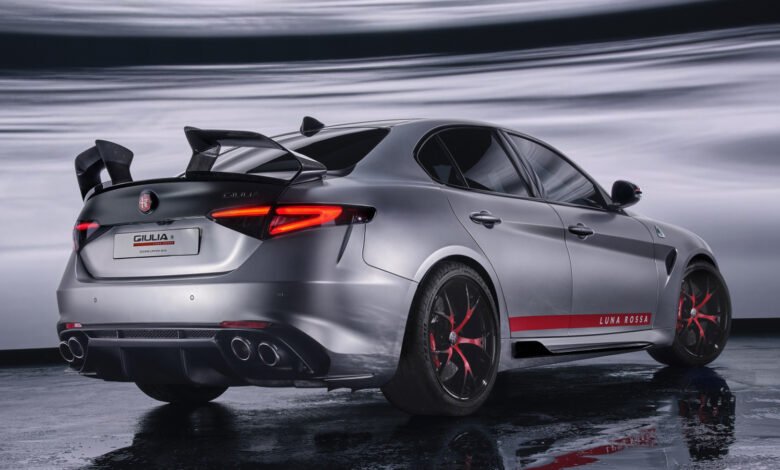
– The Giulia Quadrifoglio Luna Rossa is a new, limited special edition featuring a custom aero kit, unique paint, and interior touches.
– Only 10 units will be built to showcase Alfa Romeo’s new bespoke order service for customers seeking more than a standard vehicle.
– The car’s name and design are inspired by Alfa’s partnership with the Italian Luna Rossa sailing team.
– Its distinctive rear wing is directly inspired by boat foils, inverted to generate downforce and press the car onto the road.
The Alfa Romeo Giulia Quadrifoglio remains one of the most thrilling sport sedans money can buy, delivering a driving experience that few rivals can match when it’s performing at its peak. Its reputation, however, is often shadowed by concerns over long-term reliability, a cabin that feels dated compared to modern luxury standards, and a design that has seen minimal updates over its ten-year production run. Perhaps the solution, according to Alfa Romeo, is an exclusive new variant featuring a dramatic aerodynamic element borrowed from the world of competitive sailing. Enter the limited-run Alfa Romeo Giulia Quadrifoglio Luna Rossa.
This special edition appears to center on a comprehensive aerodynamic package, unique exterior paint, and select interior accents, distinguishing it from the standard Quadrifoglio model. The automaker plans to produce only ten examples, showcasing the capabilities of its new bespoke ordering program for clients seeking a vehicle that transcends typical showroom specifications. The Luna Rossa designation honors Alfa Romeo’s ongoing partnership with the famed Italian sailing team of the same name. This nautical inspiration is most evident in the car’s standout feature: an unconventional and prominent rear spoiler.
The design of this spoiler is directly influenced by the hydrofoils used on the team’s AC75 racing yacht. Engineers took the foil’s profile and inverted it, applying the principles to generate downforce instead of lift. The goal is not to make the car fly, but to press it more firmly onto the road surface. This dual-profile wing, supported by two central pylons, is engineered to create a high-energy vortex structure. By using a variable incidence profile, Alfa’s technicians aimed to achieve a significant aerodynamic load with a relatively compact surface area, optimizing what is known as the upwash effect for enhanced stability and grip. In essence, the car borrows technology from the sea to conquer the asphalt.
(Source: jalopnik)