World’s First Solid-State Battery Unveiled?
▼ Summary
– CES is known for announcements of innovative products with a two-year hype window, a pattern exemplified by Henrik Fisker’s failed 2018 solid-state battery promise.
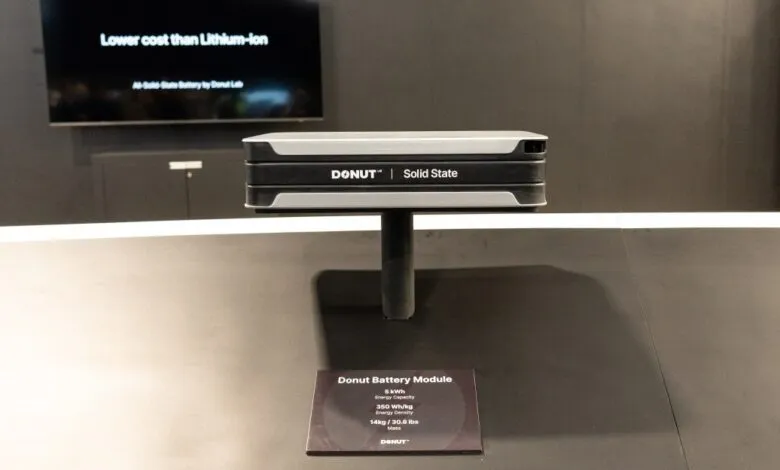
– At CES 2026, Donut Lab claims its solid-state battery is already in production, offering higher energy density, faster charging, and greater durability than lithium-ion batteries.
– The Donut Battery is said to be cheaper to manufacture, thermally stable without needing active cooling, and capable of lasting up to 100,000 charge cycles.
– Key technical challenges like dendrite formation remain undisclosed, with the CEO crediting a small, agile engineering team for the innovation.
– While parallels exist to past failed promises, the claim of immediate production and verification within weeks offers a reason for cautious optimism.
The Consumer Electronics Show has long been a stage for ambitious claims about revolutionary technology, often with delivery dates set conveniently in the future. A new announcement at CES 2026, however, breaks from that tradition by claiming a solid-state battery is not years away, but in production today. This development could signal a major shift for electric vehicles, promising significant improvements in cost, charging speed, and longevity without the typical waiting period associated with such breakthroughs.
History provides ample reason for caution. In 2018, another company promised mass-produced solid-state batteries within two years, a pledge that ultimately faded without a product ever reaching the market. The latest claim comes from Donut Lab, an EV technology startup. Its CEO, Marko Lehtimaki, asserts their new battery cell is already being manufactured, a key distinction from previous vaporware announcements.
The fundamental promise of solid-state technology is a battery that replaces the liquid electrolyte found in conventional lithium-ion cells with a solid material. This seemingly simple change carries profound implications. The most significant impact is on durability and lifespan, potentially creating a component that outlasts the vehicle it powers. Donut Lab publishes impressive specifications for its battery, including an energy density of 400 watt-hours per kilogram. This figure represents roughly a 30 percent increase over modern lithium-ion packs, which could translate directly into greater driving range for an EV of equivalent weight.
Remarkably, Lehtimaki states these advanced cells are cheaper to produce. The first application will be in the Verge TS Pro motorcycle, where the switch to the new technology reportedly lowered costs. The batteries are also said to accept an extremely rapid charge, with a full cycle possible in as few as five minutes. For the initial motorcycle application, a ten-minute charge is quoted. On longevity, the company promises up to 100,000 charge cycles, though the first partner is conservatively rating them for 10,000. Even that lower number dwarfs the approximately 1,500 cycles expected from a typical EV battery pack today.
Thermal performance presents another advantage. The batteries are described as extremely stable, operating with nearly full capacity even in extreme cold down to -30 degrees Celsius. This stability reduces or eliminates the need for complex active cooling systems in a vehicle, saving additional weight and complexity. A partner company confirmed the design may require only simple enclosure management rather than dedicated battery cooling.
A critical hurdle for solid-state batteries has been the dendrite issue, microscopic lithium growths that can bridge the electrolyte and cause short circuits. How Donut Lab solved this persistent problem remains unclear, as Lehtimaki declined to share specific chemical details or patent information, noting more would be revealed in coming months. He attributes their progress to a small, agile engineering team capable of rapid iteration, suggesting that a focused group can out-innovate larger, slower organizations.
While speculation has linked the technology to another Finnish startup, Lehtimaki denies this, stating the design is the result of internal development work dating back to 2018. The cells are currently being produced in Finland at an initial capacity of about one gigawatt-hour, with the ability to establish U.S. production if demand warrants it. The chemistry is also said to avoid conflict or heavily regulated materials, simplifying the supply chain.
Skepticism is natural, given the parade of unfulfilled promises in this sector. The parallels to past announcements, including offhand mentions of future applications for consumer electronics, are undeniable. Yet the decisive difference is the claimed timeline. Instead of a two-year horizon for investor excitement, the company asserts its product is real and will be demonstrated imminently. That alone offers a new reason for cautious optimism, with the proof set to arrive not in years, but in a matter of weeks.
(Source: The Verge)