Samsung, Intel OLED Tech Boosts Laptop HDR Battery Life
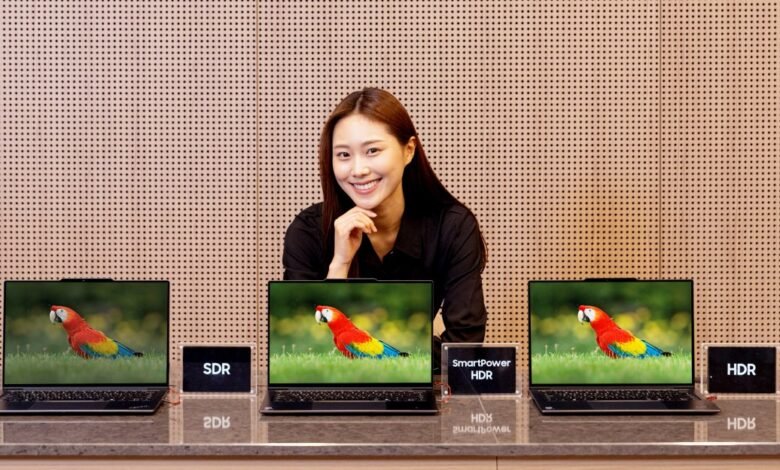
▼ Summary
– General laptop tasks like web browsing can run at lower voltage, while HDR content like gaming requires higher brightness and voltage.
– Traditional HDR modes are locked at maximum brightness, leading to high power use even for standard tasks.
– This power inefficiency causes many laptops to default to SDR mode, despite HDR’s superior color and brightness.
– SmartPower HDR™ reduces OLED pixel power consumption by up to 22% in general use and 17% during HDR content.
– In general usage, SmartPower HDR™ achieves power consumption levels comparable to SDR mode.
A significant advancement in display technology promises to extend the battery life of premium laptops without sacrificing visual quality. The collaboration between Samsung Display and Intel has yielded a new power-saving feature for OLED panels, directly addressing a major drawback of current high dynamic range (HDR) implementations. This innovation allows laptops to intelligently manage power consumption based on the content being viewed, making the vibrant experience of OLED HDR more practical for everyday mobile use.
The core issue with existing HDR technology on laptops is its inherent inefficiency. Traditional HDR modes force the display to operate at maximum brightness continuously, consuming a substantial amount of power regardless of whether you are watching a movie or simply reading an email. This constant high-voltage demand leads to rapid battery drain, which is why many manufacturers and users often disable HDR entirely, reverting to the less power-hungry but visually inferior Standard Dynamic Range (SDR) mode. Common tasks like web browsing or working on documents do not require the peak luminance that HDR provides for video or gaming, yet the display hardware has lacked the granular control to adjust accordingly.
The newly developed solution, termed SmartPower HDR™, introduces a dynamic voltage scaling mechanism. This system allows the OLED display to operate at lower voltage levels during general computing tasks, then seamlessly ramp up to the higher voltages needed for true HDR content. For instance, scrolling through a document or reading a website can function efficiently at a reduced power state. Conversely, when launching a game or playing a high-definition video, the display instantly delivers the full brightness and contrast that makes HDR so compelling. This intelligent adjustment can reduce the power consumption of OLED pixel emission by up to 22% during general usage and by up to 17% when displaying actual HDR content. Perhaps most importantly, in those everyday usage scenarios, the power draw becomes comparable to that of operating in SDR mode, finally eliminating the battery life penalty that has long been associated with enabling HDR.
This technological leap is a result of deep integration between Samsung’s advanced OLED panel designs and Intel’s display driver and power management frameworks. By optimizing the signal interface and power delivery at a hardware and driver level, the system achieves these efficiency gains without any perceptible lag or reduction in image quality when switching between power states. For consumers, this means the potential to leave HDR enabled permanently on supported laptops, enjoying richer colors and deeper blacks across all applications while benefiting from markedly improved battery endurance. It represents a meaningful step toward making premium display technology truly sustainable for mobile platforms.
(Source: The Verge)


