Linux’s “New” Mount API Finally Gets Official Man Page Documentation
▼ Summary
– Michael Larabel is the founder and principal author of Phoronix.com, which he launched in 2004.
– The website focuses on improving the Linux hardware experience for its users.
– He has authored over 20,000 articles on topics like Linux hardware support, performance, and graphics drivers.
– Larabel is also the lead developer of several automated benchmarking tools, including the Phoronix Test Suite.
– He is available for contact through his personal website and can be followed on social media platforms like Twitter and LinkedIn.
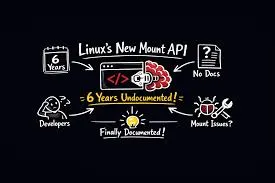
The long-awaited official documentation for the Linux kernel’s modern mount API has finally been published. This marks a significant milestone for system administrators and developers who rely on this powerful interface for managing filesystems. The new man pages provide the authoritative reference that has been missing since the API’s introduction years ago, offering crucial guidance for its proper use.
For a considerable time, working with the new mount API required developers to piece together information from various kernel source files, mailing list discussions, and scattered online resources. The absence of centralized, official documentation created a steep learning curve and increased the risk of implementation errors. The newly released man pages, now part of the `man-pages` project, directly address this gap. They deliver comprehensive, structured explanations of the system calls, data structures, and concepts that form the foundation of the API.
The modern mount API was developed to replace the aging, monolithic `mount(2)` system call, which had accumulated decades of complexity and limitations. The new design offers a more flexible, extensible approach. It uses a series of distinct system calls to create a filesystem context, configure its parameters, and then perform the actual mount operation. This methodical, step-by-step process provides finer control and is better suited for today’s complex containerized and virtualized environments.
Key system calls like `fsopen()`, `fsconfig()`, `fsmount()`, and `fspick()` are now thoroughly documented. The man pages detail their parameters, return values, and potential error codes. Furthermore, they explain the lifecycle of a mount context, from creation and configuration to attachment and disposal. This clarity is invaluable for anyone writing software that programmatically manages mounts, such as container runtimes, virtualization tools, or specialized system utilities.
The documentation also sheds light on advanced features and security considerations. It covers topics like the propagation of mount events between namespaces, the creation of bind mounts and shared subtrees, and the handling of user namespaces. For security-conscious deployments, understanding these nuances is non-negotiable. The official guide helps ensure that mounts are configured in a secure and predictable manner, reducing potential attack surfaces.
With this documentation now in place, the adoption and correct utilization of the modern mount API are poised to accelerate. Developers can move forward with greater confidence, building more robust and secure applications. The man pages serve not just as a reference, but as a foundational educational tool that will shape best practices for years to come, solidifying the API’s role as the standard for filesystem management in Linux.
(Source: Phoronix)