How the Manifold Revolutionized Our View of Space
▼ Summary
– Manifolds are mathematical shapes that appear flat locally but can have complex global structures, fundamentally changing how mathematicians view space.
– Introduced by Bernhard Riemann in the 19th century, manifolds transformed space from a physical setting into an abstract, well-defined object of study.
– This new perspective enabled the rigorous exploration of higher-dimensional spaces and gave rise to modern topology.
– Manifolds are now central to many fields, including geometry, physics, and data analysis, providing a common vocabulary for solving diverse problems.
– They represent a foundational shift from Euclidean geometry, where rules like parallel lines and triangle angles are fixed, to curved spaces where these properties can change.
Imagine standing in an open field. The ground beneath your feet stretches to the horizon, appearing perfectly flat. Yet we know our world is a sphere, a fact hidden by our limited, local perspective. This simple observation lies at the heart of a profound mathematical concept: the manifold. Introduced by Bernhard Riemann in the 19th century, manifolds revolutionized our understanding of space itself, transforming it from a mere physical backdrop into a rich, abstract object worthy of deep study. This new framework provided the essential language for exploring higher-dimensional and curved spaces, catalyzing the birth of modern topology and becoming indispensable to fields ranging from geometry and physics to data analysis.
For centuries, geometry was confined to the familiar, flat realm of Euclidean space, the intuitive world where parallel lines never meet and a triangle’s angles always sum to 180 degrees. This was considered the only “space,” a direct model of physical reality. However, by the early 1800s, pioneering mathematicians began to question this assumption, investigating curved spaces like spheres or saddle shapes. In these alternative geometries, the foundational rules changed; parallel lines could converge, and triangles could have very different angle sums. The mathematical establishment initially resisted this radical shift in thinking.
A key figure in pushing these ideas further was Bernhard Riemann. A reserved young man who had initially intended to study theology, Riemann was ultimately drawn to mathematics. In 1849, he chose to pursue his doctoral studies under the guidance of Carl Friedrich Gauss, who was already investigating the intrinsic properties of curves and surfaces, how they behave based solely on their own geometry, independent of any surrounding space. This mentorship would prove pivotal.
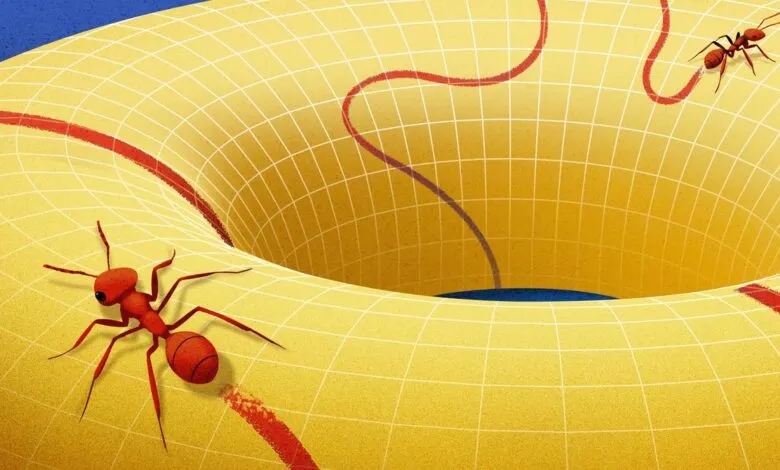
Riemann’s groundbreaking work provided a rigorous way to describe these new kinds of spaces. A manifold, in essence, is a shape that appears flat when you zoom in closely enough, much like the Earth seems flat from a human vantage point. This local simplicity, paired with potential global complexity, gave mathematicians a powerful and flexible vocabulary. They could now systematically study spaces of any dimension and curvature, moving beyond the constraints of classical Euclidean geometry.
Today, manifolds are as fundamental to advanced mathematics as an alphabet is to language. They offer the basic structural components needed to build and solve complex problems across numerous disciplines. As one mathematician analogized, knowing the Cyrillic alphabet doesn’t mean you know Russian, but trying to learn Russian without it would be impossible. Manifolds provide that essential script, allowing researchers to articulate and explore the intricate architecture of abstract space, forever changing our conceptual landscape.
(Source: Wired)