Audi’s Inline-Five: 50 Years of Unconventional Power
▼ Summary
– Audi’s inline-five cylinder engine and Quattro all-wheel drive system revolutionized motorsport, most famously in Group B rally, leading to 24 victories and four WRC titles.
– After Group B, Audi successfully competed in American series like Trans Am and IMSA GTO with turbo five-cylinder cars, with the 200 Quattro sweeping the 1988 Trans Am championship.
– The first mass-production inline-five appeared in the 1976 Audi 100, chosen over a six-cylinder due to space constraints, and its turbocharged version became the basis for the legendary Quattro coupe.
– After being discontinued in the late 1990s, the inline-five was revived in 2009 in models like the TT RS and RS3, featuring modern technology but faces potential discontinuation due to emissions regulations.
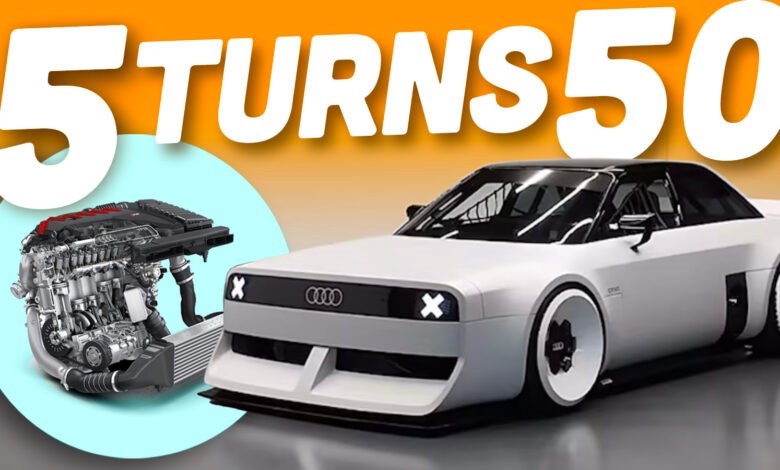
– To mark the engine’s 50th anniversary, Audi apprentices built the GT50 concept car, a tribute to its late-’80s racing cars, though a production version is considered unlikely.
For five decades, the distinctive growl of Audi’s five-cylinder engine has defined an unconventional path to performance. This unique powerplant carved its legend not in the mainstream, but on the world’s most demanding stages, from the treacherous dirt of Group B rally to the high-speed ovals of American racing. Its story is one of engineering boldness, creating a charismatic and potent engine that became synonymous with the brand’s competitive spirit and technical innovation.
The engine’s competitive debut is forever linked to the Audi Quattro, a car that revolutionized rallying. The combination of turbocharged five-cylinder power and the novel all-wheel-drive system provided an unbeatable advantage, securing world championships and etching the Quattro’s name in motorsport history. When Group B ended, Audi’s engineers refused to retire the potent inline-five. They instead turned to American circuits, where the engine faced off against thunderous V8s. In the Trans Am series, the Audi 200 Quattro dominated, while the extreme, tube-frame Audi 90 battled in IMSA GTO, proving the five-cylinder’s versatility and potency against all odds.
This celebrated engine has an unusual origin. In the early 1970s, Audi needed more power than its four-cylinders could provide. A conventional inline-six was considered but rejected due to space and weight distribution concerns. The engineers chose a more novel solution: adding a cylinder to their existing four-cylinder block. The result was the first mass-production inline-five, debuting in the 1976 Audi 100. This pragmatic yet ingenious decision birthed an icon. A turbocharged version soon followed, directly leading to the Quattro’s rally weapon and a lineage of road-going legends like the ferocious Sport Quattro.
The engine’s competition resume is staggering. Beyond rally and touring car glory, it powered Walter Röhrl’s Pikes Peak conquering Sport quattro S1. In the 1990s, it found a new home in the Porsche-engineered RS2 Avant, a car that launched Audi’s famed line of high-performance wagons. Journalists of the era noted its explosive, lag-filled power delivery, a raw, mechanical character that stood in stark contrast to today’s smoother turbo engines. After a period of dormancy, Audi brilliantly revived the layout in 2009 with a new, transversely-mounted 2.5 TFSI engine for models like the TT RS and RS3. This modern iteration uses advanced technology like plasma-coated cylinder liners and a sophisticated valvelift system to balance thrilling performance with contemporary efficiency demands.
Today, the inline-five faces an uncertain future amid stringent emissions regulations, with its continuation debated. However, Audi recently celebrated its 50th anniversary with a fitting tribute: the apprentice-built GT50 concept. Based on a modern RS3, the GT50 wears a boxy, retro-inspired body that directly honors the 200 Trans Am and 90 IMSA GTO racers, complete with period-correct turbofan wheels. It serves as a potent reminder of the engine’s glorious past, even as enthusiasts hope for its future.
Driving a car equipped with this engine is a unique experience. The power delivery is strong and linear, but the true magic lies in its soundtrack. It possesses a raspy, metallic warble entirely its own, often described as sounding like half a V10, yet with a distinct character that is unmistakably Audi. In an automotive landscape increasingly dominated by homogenized powertrains, the persistence of Audi’s charismatic five-cylinder is a welcome anomaly, a testament to engineering personality that resonates deeply with driving enthusiasts.
(Source: The Autopian)