Samsung Odyssey G7 40-Inch Review: Fast, Gorgeous & Immersive

▼ Summary
– The Samsung Odyssey G7 S40FG75 is a 40-inch, 1000R curved, ultra-wide (21:9) gaming monitor offering an immersive, wraparound visual experience at a lower price point than premium OLED displays.
– It features a high-performance VA panel with a 5120×2160 resolution, 180Hz refresh rate, HDR support, and excellent measured contrast and color gamut coverage for a vivid picture.
– The monitor has a well-implemented overdrive for motion clarity, but users cannot enable it simultaneously with Adaptive-Sync, requiring a choice between the two features.
– Its design includes practical features like rear-facing inputs for easy connectivity, an intuitive OSD control pad, and RGB LED lighting, though it lacks internal speakers.
– Overall, it is presented as a compelling and high-performance alternative to more expensive OLED monitors, delivering a highly immersive and addictive gaming experience.
For gamers seeking a truly immersive experience without the premium price tag of OLED technology, the Samsung Odyssey G7 S40FG75 presents a compelling and feature-rich alternative. This 40-inch ultrawide monitor combines a dramatic 1000R curvature with a high-resolution 5120×2160 panel and a blistering 180Hz refresh rate, creating a wraparound visual environment that pulls you directly into the action. It delivers a vibrant, high-contrast picture and the smooth performance demanded by serious gaming, all while costing significantly less than comparable OLED displays.
The world of high-performance gaming monitors offers few options as visually dramatic as those with an extreme curve. A 1000R radius, like the one on this Samsung model, means the screen bends to match the natural curve of your field of vision. Paired with a 21:9 ultrawide aspect ratio, the effect is profoundly immersive, offering a taste of virtual reality’s engagement without needing a headset. While many new ultrawide screens utilize premium OLED panels with prices well over a thousand dollars, this model employs VA (Vertical Alignment) technology to deliver a stunning picture at a more accessible point.
Specifications are a key part of its appeal. The 40-inch VA panel boasts a native 5120×2160 resolution (5K ultrawide), resulting in a sharp 140 pixels per inch. It supports a 180Hz maximum refresh rate and is compatible with both AMD FreeSync and NVIDIA G-Sync for tear-free gameplay. The monitor covers a wide DCI-P3 color gamut, is DisplayHDR 600 certified, and uses an edge-lit LED backlight with local dimming zones to enhance contrast in HDR content.
That intense 1000R curve creates a circle of monitors just two meters in radius, encouraging you to sit close and become enveloped by the display. The high pixel density ensures everything looks crisp, though driving that many pixels at high frame rates requires powerful graphics hardware. The 180Hz refresh is exceptionally fast for an ultrawide of this resolution, outpacing many 34-inch competitors. VA panel technology is the star here, providing the highest contrast ratios available in LCD monitors. While viewing angles aren’t as wide as on an IPS panel, they are far superior to older TN screens. The local dimming feature, though limited to a few edge-lit zones, provides a measurable boost to contrast in HDR mode, with measured ratios soaring well beyond the native specification.
Gaming-centric features are somewhat basic, offering aiming points and a black level adjuster but lacking more advanced tools like a frame counter or sniper mode. The overdrive function for motion clarity is well-tuned but presents a notable quirk: it cannot be activated simultaneously with Adaptive-Sync. Users must choose between the variable refresh rate technology or the best motion performance, which is an unusual limitation. However, if your system can consistently hit 180 frames per second, you can disable Adaptive-Sync and use overdrive without penalty.
The monitor includes thoughtful extras, such as customizable RGB LED lighting (marketed as Infinity Core) around the stand’s hub and rear-facing USB ports that simplify connecting peripherals. Inputs are comprehensive, featuring DisplayPort 1.4 and two HDMI 2.1 ports, alongside a 3.5mm headphone jack. Notably, there are no built-in speakers. An intuitive navigation pad located beneath the screen provides easy access to a well-organized on-screen display menu.
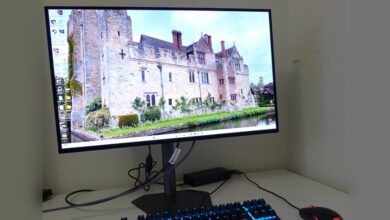
Setting up the Odyssey G7 is straightforward, with a tool-free assembly that securely attaches the panel to its solid, heavy metal stand. The stand itself offers a robust range of adjustments, including height, tilt, and swivel, all with a firm, premium feel. The monitor’s design is bold and modern, with minimal front branding. The rear-facing inputs, while making cable management slightly more visible, are a significant ergonomic benefit for easily connecting and disconnecting devices.
The on-screen menu has a clean, dashboard-like layout. Within the Game menu, users will find the overdrive settings, Adaptive-Sync toggle, and aiming points. The Picture menu is comprehensive, offering multiple presets and full calibration controls for color temperature, gamma, and gamut. The local dimming control has three settings, with ‘High’ delivering the best contrast performance. A standout feature for HDR content is the dynamic tone mapping option, which actively adjusts the image to better display the full dynamic range of the content, a feature that significantly enhances the HDR viewing experience and is regrettably rare on many monitors. The 21:9 aspect ratio also enables versatile Picture-by-Picture and Picture-in-Picture modes for multitasking with two video sources.
Out-of-the-box image accuracy is excellent, making calibration optional for most users. The ‘Eco’ picture mode serves as a great starting point, offering full brightness control despite its name. Minor adjustments to the RGB gains and gamma can yield a slight boost in color saturation and overall image quality. For HDR content, enabling dynamic tone mapping and setting local dimming to ‘High’ is highly recommended.
In practical use, the gaming experience is where the Odyssey G7 truly shines. The combination of the extreme curve and large 40-inch canvas creates an unparalleled sense of immersion, filling your peripheral vision and making in-game elements feel tangibly closer. This sensation is markedly more intense than on a 34-inch ultrawide. Motion handling is very good with the overdrive enabled, though it doesn’t match the perfect pixel response of an OLED. Achieving the ideal tear-free experience at 180Hz requires a top-tier graphics card, like an RTX 4090. If your frame rate fluctuates, using Adaptive-Sync becomes the more practical choice, albeit without the overdrive enhancement.
HDR performance is impressive, delivering vibrant colors and strong contrast that, while not matching the infinite contrast of OLED, provides a deeply satisfying visual experience. The monitor is also a pleasure for daily productivity, with its PBP functionality being particularly useful for viewing two full-screen sources side-by-side. The extreme curve can cause minor distortion for documents placed at the far edges, but central content remains perfectly sharp and undistorted.
Ultimately, the Samsung Odyssey G7 S40FG75 is a standout monitor that delivers exceptional gaming performance and a vivid, engaging picture. It captures roughly ninety percent of the premium OLED experience for a substantially lower cost. Its aggressive curvature generates an immersive effect that flat or moderately curved screens cannot replicate, and its 40-inch size makes every game feel larger than life. It represents one of the most captivating and addictive displays available for both play and work.
(Source: Tom’s Hardware)