HyperX Cloud Alpha 2 Wireless Review: Is It Worth It?
▼ Summary
– The HyperX Cloud Alpha 2 Wireless headset offers exceptional 250-hour battery life, allowing weeks of use without charging and outperforming most competitors.
– It features seamless simultaneous 2.4 GHz and Bluetooth connectivity for effortless switching between multiple devices like PCs and MacBooks.
– Sound quality is enhanced with new 53mm dual-chamber drivers, delivering clean, detailed audio suitable for gaming and music without listener fatigue.
– Comfort is excellent with breathable microfiber ear pads, a memory-foam headband, and durable construction that remains lightweight during extended wear.
– The included RGB base station provides advanced controls and multi-device management, but adds significant cost for features many users may not fully utilize.
Spending two weeks with the HyperX Cloud Alpha 2 Wireless reveals a headset built for convenience and endurance. This latest model takes a beloved design, upgrades the audio drivers, and introduces both 2.4GHz wireless and Bluetooth connectivity, all supported by a feature-rich RGB base station. Priced at $299, it confidently enters a competitive field, though its true value depends heavily on whether you’ll actually use that dock to its full potential.
Battery performance stands out immediately. While the earlier Cloud Alpha Wireless achieved a staggering 300 hours, this version offers a quoted 250 hours. On paper that seems like a step back, but in daily use it remains extraordinarily long-lasting. I used it for nightly gaming sessions, Teams calls, and Bluetooth music streaming without ever worrying about power. Even with both wireless radios active, the battery held strong for weeks, making the “charge it once a month” promise a reality and keeping HyperX far ahead of competitors that typically last between 40 and 70 hours.
Audio quality gets a meaningful upgrade thanks to new 53mm dual-chamber drivers. HyperX promises reduced distortion, and the Alpha 2 delivers a clean, well-defined sound that impresses at this price. In games like The Outer Worlds 2, environmental details come through richly, while combat effects remain crisp and distinct. Footsteps in Battlefield 6 cut clearly through intense action without sounding harsh. Bass response is full and controlled, never muddy or overwhelming, while mid-range tones stay articulate and balanced.
Comfort follows the classic HyperX formula, which is to say, it’s excellent. The microfiber cloth ear pads stay breathable over long periods, and the memory-foam headband provides just the right amount of softness. Swiveling earcups adapt naturally to your head shape, and the clamping force feels secure without creating pressure. A steel-reinforced headband and aluminum yokes keep the build solid and creak-free, yet the overall weight never becomes burdensome, even during extended editing marathons.
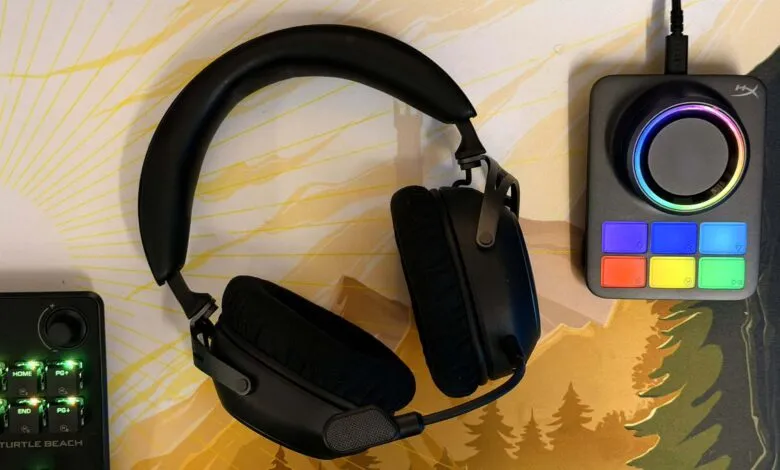
Then there’s the base station. HyperX markets it as an audio command center, and it truly is a polished accessory. The central dial offers a premium feel, programmable buttons handle volume, source switching, or custom macros, and moving between devices is seamless. If your desk supports a PC, multiple consoles, and various audio peripherals, this hub justifies its footprint. The RGB lighting is understated and can be adjusted or turned off entirely.
However, if your setup is simpler, say, just a gaming PC and a work laptop, the dock may feel excessive. Its real strength lies with streamers and multi-device power users who regularly switch audio sources or use hardware-level shortcuts. For everyday use, it mostly serves as an elegant desk ornament while the headset itself handles the wireless heavy lifting.
Connectivity is where the Cloud Alpha 2 Wireless truly excels. Moving between a Windows PC and a macOS laptop is effortless. The 2.4GHz dongle stays in the PC, Bluetooth remains paired to the MacBook, and both connections remain active without interference. Incoming calls on the Mac pause game audio cleanly, and resuming play is instant, no reconnection delays or menu diving required. Unlike some competing models, Bluetooth is built directly into the headset, so you can use it on the go without the dock.
Microphone performance is acceptable but not exceptional. It’s clear enough for Discord or team chats, though the sound comes across compressed and lacks depth. Plosives are managed well, the mute function works reliably, and AI noise reduction is effective, but it further compresses the signal. While fine for daily communication, it won’t replace a dedicated microphone. Alternatives like the Astro A50 X or Razer BlackShark V3 offer superior mic quality for streamers or content creators.
Pricing remains a sticking point. At $300, the Alpha 2 faces fierce rivals. The Logitech Astro A50 Gen 5 with PlaySync supports Xbox, PS5, and PC integration, includes a stronger microphone, and offers magnetic charging, making it a compelling all-in-one option. Meanwhile, the Audeze Maxwell delivers outstanding audio clarity and a quality built-in mic. HyperX’s base station is more customizable, which may appeal to streamers and multi-device professionals, but the value proposition narrows for average users.
So, who is the Cloud Alpha 2 Wireless for? It’s a thoughtful evolution focused on real-world usability: effortless multi-device switching, exceptional battery life, top-tier comfort, and lively, detailed sound. The dock is powerful if your setup demands it, and the headset itself feels like a polished, durable successor to a trusted line.
That said, the microphone hasn’t improved enough, and the price sits higher than some may prefer. If the docking station aligns with your workflow, or you’re a streamer who will use its advanced features, this package could justify the cost. Otherwise, watch for discounts, consider the original Cloud Alpha Wireless, evaluate the Razer BlackShark V3, or explore more console-focused options like the Logitech Astro A50 if you regularly game across multiple platforms.
(Source: PC Gamer)