Apple MacBook Pro M5 Review: New Chip, Same Excellence
▼ Summary
– The M5 MacBook Pro is nearly identical to last year’s M4 model, with unchanged design, screen, ports, and most features.
– Key upgrades include a slightly faster M5 chip and significantly faster SSD storage, which speeds up large file handling.
– Performance improvements are modest for general use but more noticeable in creative apps and AI workflows, with benchmark gains of 8-33%.
– It remains an excellent choice for users upgrading from older laptops, offering strong performance, great battery life, and premium features.
– While not ideal for demanding AAA gaming, it excels for creative work, everyday tasks, and less demanding indie games.
The latest Apple MacBook Pro with the M5 chip delivers a familiar yet refined experience, building directly upon the solid foundation laid by its M4 predecessor. For anyone already using last year’s model, this update feels more like a subtle tune-up than a complete overhaul. The core design, screen quality, port selection, and overall build remain identical. However, if you’re upgrading from an older Intel-based Mac or an early M-series model, the performance uplift and significantly faster storage will be immediately apparent and genuinely worthwhile.
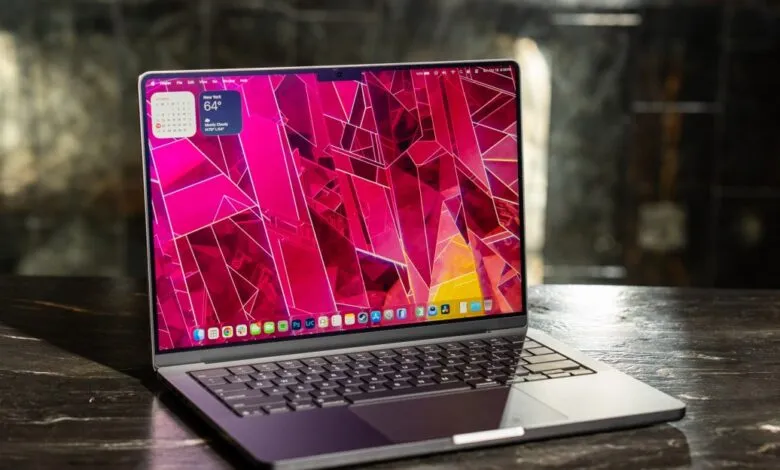
This year’s base model MacBook Pro essentially mirrors the M4 version in every physical aspect, the dimensions, weight, and color options are unchanged. That consistency isn’t a drawback, though, because the current design already matches what you get with the higher-end M4 Pro and Max models. You still benefit from the same excellent port array and upgrade possibilities. Pricing starts at $1,599, positioning it as Apple’s most accessible pro-level laptop.
Looking at the components, the machine earns top marks in several key areas. The display is superb, the webcam performs excellently, and the touchpad and speakers are among the best available. The keyboard and microphone are very good, and the port selection is practical, though some might wish for even more connectivity.
Beyond the modest speed increase from the M5 chip, the most notable upgrade is the storage. Every SSD configuration in the M5 MacBook Pro, from the 512GB base model up to the massive 4TB option, operates faster than the equivalent tier in the M4. For instance, the 1TB SSD in the M5 more than doubles the sequential read and write speeds of the M4’s 1TB drive, bringing it in line with the quicker storage found in the Pro and Max variants.
Our review unit included a 1TB SSD and the optional anti-glare display, bringing the total to $1,949. These are nice enhancements if your budget allows, but they aren’t essential for most users. The base M5 configuration, with a glossy screen, 16GB of RAM, and 512GB of storage, will capably handle the majority of professional tasks. It’s worth noting that spending just a bit more could get you into a 14-inch M4 Pro model, which offers greater performance, more RAM, and future-proof Thunderbolt 5 ports.
In synthetic benchmarks, the M5 shows clear, if not dramatic, improvements. CPU tests in Geekbench and Cinebench saw gains between 8 and 16 percent. More importantly, tests using PugetBench for creative applications like Adobe Premiere Pro, Photoshop, and DaVinci Resolve showed more substantial jumps, with scores improving by 17 to 33 percent.
Will you feel these speed gains in everyday use? If you’re coming from an M4, probably not in most general tasks. The M4 was already exceptionally fast. The real-world difference becomes more noticeable in specific scenarios, particularly those leveraging AI. The M5 introduces new Neural Accelerators on its GPU cores, which Apple claims can accelerate AI-related tasks by up to 3.5 times compared to the M4. This boost is most apparent in specialized workflows, such as using AI upscaling in Topaz Video or the Enhance Speech feature in Premiere Pro.
For users upgrading from much older Intel Macs or early M1 models, the performance leap will be far more significant, especially when combined with the much faster SSD speeds.
Apple continues to promote Mac gaming, so we put the M5 to the test with Cyberpunk 2077. The game’s “For this Mac” preset imposes significant constraints, locking the resolution to around 1080p and the frame rate to 30fps. While playable, it’s not the ideal way to experience a visually stunning game. Disabling V-sync allowed the frame rate to reach a more respectable average of 48fps on the M5, a slight improvement over the M4’s 40fps. In more demanding benchmarks at higher resolutions and settings, a comparably priced Windows gaming laptop with a dedicated GPU delivered more than double the frame rate, underscoring that high-end AAA gaming remains a Windows stronghold. That said, the MacBook Pro handles less demanding indie titles like Hollow Knight: Silksong and Hades II with ease.
![Image of the MacBook Pro M5 showing its port selection]
Despite its limitations for hardcore gaming, the entry-level MacBook Pro remains an outstanding choice for creative students and professionals involved in photo or video editing, especially if the M4 Pro or Max models stretch beyond their budget. It’s the pro-level machine for everyday users who need more power than a MacBook Air can provide, or who simply prefer a laptop with a superior display, louder speakers, and additional ports.
The keyboard and trackpad continue to be best-in-class, offering a precise and comfortable typing experience. Battery life is another strong suit; the 14-inch Pro model lasted through a full, nearly nonstop nine-hour workday involving productivity apps, photo editing in Lightroom, and music streaming. Even under heavy load, the laptop stays relatively cool and quiet, with its fans rarely becoming intrusive.
While rumors suggest a more significant MacBook Pro redesign is likely a year or so away, the current M5 model stands as an excellent machine in its own right. It occupies a sweet spot in Apple’s lineup, offering pro-level features at a more accessible price. This annual update may not be thrilling, but it undeniably makes a great laptop just that little bit better.
(Source: The Verge)