Styx: Blades of Greed Review – A Fun, Flawed Stealth Adventure
▼ Summary
– Styx: Blades of Greed is praised as the best traditional stealth game in a decade, focusing entirely on sneaking and avoiding detection rather than combat.
– The game features highly replayable, intricate levels and a clever quick-save system that encourages experimentation after failure.
– It suffers from significant technical issues on PC, including bugs, crashes, and performance problems, alongside amateurish voice acting and cutscenes.
– The story and many moments are designed for series fans and may be confusing or lack impact for newcomers to the Styx franchise.
– Despite its flaws, the core stealth experience is very satisfying, especially for players seeking a pure, challenging sneak-focused game.
For fans of pure, unforgiving stealth, Styx: Blades of Greed stands out as a remarkable and deeply satisfying experience that feels like a classic from a bygone era. It focuses entirely on the tense, methodical art of staying hidden, offering intricate levels that reward patience and cleverness. However, its brilliance is somewhat tarnished by a collection of technical problems and production shortcomings that may deter players who prefer more polished, modern adventures.
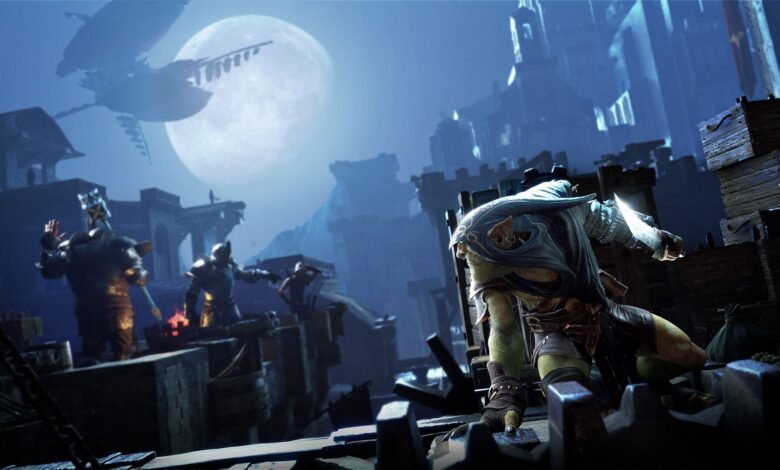
This game distinguishes itself from contemporary stealth-action hybrids. You won’t find yourself engaging in large-scale combat or using social stealth to blend into crowds. The focus is purely on sneaking, using shadows, and avoiding detection at all costs. You control Styx, a goblin who is decidedly not a warrior. If guards spot you, the outcome is almost always a quick death. You might handle one or two weaker foes in a desperate moment, but your health is minimal, and any open conflict rapidly escalates into a hopeless situation as reinforcements arrive. Even the sound of your footsteps can cascade into disaster, forcing you to move carefully at a near-constant crouch. While this high-stakes approach can be punishing, the immense payoff for a perfectly executed plan makes it compelling.
A standout feature is the ingenious quick-save system. Often criticized in other games as “save scumming,” here it is an essential and encouraged tool. With a simple press of the left thumbstick, you create an instant save point, indicated by a subtle on-screen cue. Dying, whether from a guard’s blade, a fatal fall, or even touching water (which dissolves goblins instantly), simply returns you to that save after a brief load. This mechanic transforms failure from a frustration into an invitation for experimentation. It liberates you to test bold ideas, like using an environmental hazard on a patrol or attempting a risky takedown, without the fear of significant setback.
The game’s three primary levels are vast, multi-layered playgrounds designed for exploration and replay. They are packed with verticality and hidden pathways, including ledges, vents, crawlspaces, and hiding spots inside furniture. The incredible sense of mobility enhances this exploration; Styx moves with a fast, scurrying gait and has a rapid double-jump, making navigation across rooftops and through corridors feel agile and joyful. While there are only a few main maps, they are densely packed. Side objectives and collectibles encourage thorough investigation, and a smart progression system gradually provides new tools like grapple hooks, which unlock entirely new sections of these environments, giving them a Metroidvania-like quality.
As a master infiltrator, Styx has a versatile arsenal. An upgrade tree offers new abilities, with the most interesting tied to Quartz, a mysterious material central to the plot. These include powerful options like temporarily mind-controlling enemies or slowing down time. He also has access to returning favorites from earlier games, such as short-term invisibility and decoy clones, alongside standard tools like noise-making bottles and acid traps. You can complete the game using only basic tactics, but engaging with the full suite of abilities opens up thrilling creative possibilities.
Unfortunately, the experience has several rough edges. The game is a direct sequel, and prequel, to titles released nearly a decade ago, and its narrative assumes familiarity with those earlier stories. New players will likely find the plot confusing, and impactful moments, like revisiting a location from a past game, will lose their resonance. The production values are also inconsistent. While the voice acting for Styx himself is full of character, many supporting performances sound amateurish. Cutscenes are cheaply animated, with awkward character movements and jarring edits.
More critically, the PC version suffers from a variety of technical issues. Players may encounter frame rate hitches, subtitle typos, and bugs that cause characters to clip through geometry or be seen through walls. Occasional crashes can also occur. The core stealth gameplay is strong enough to withstand these problems for dedicated fans, but they undoubtedly impact the overall polish. The game includes three difficulty levels and several colorblindness filters in its accessibility menu, but options beyond that are limited.
Ultimately, Styx: Blades of Greed is a game of stark contrasts. It delivers a masterclass in pure stealth design with fantastic levels and clever systems, yet wraps it in a package that feels technically unrefined and narratively insular. It is a must-play for purists of the genre who can overlook its flaws, but a harder sell for anyone seeking a seamless, accessible modern adventure.
(Source: TechRadar)


