The Ultimate Final Preview
▼ Summary
– Pokémon Pokopia is the franchise’s first life-simulation game, featuring a Ditto protagonist that transforms into a human to search for its lost trainer.
– The core gameplay loop involves attracting Pokémon by creating habitats, learning skills from them, and using those skills to further customize and improve the world.
– A key design philosophy is fostering direct communication and friendship with Pokémon, achieved by making the player character a Pokémon rather than a trainer giving orders.
– Progression is driven by objectives like increasing an area’s Environment Level and Pokémon Comfort Levels, often by fulfilling Pokémon requests and crafting furniture.
– The game includes four-player multiplayer and is designed for long-term engagement, with an estimated 20-40 hours to the credits and ongoing daily events.
For many fans, the Pokémon franchise evokes a uniquely comforting feeling, set in a charming world filled with loyal companions. While past titles have offered relaxing moments, none have fully embraced a life-simulation format, until now. Pokémon Pokopia represents a bold new direction, immersing players in a cozy gameplay loop centered on discovery, restoration, and direct friendship with Pokémon. My hands-on time revealed a deeply engaging experience that hooks you from the very first hour, promising a fresh way to interact with this beloved universe.
The adventure begins with a Ditto awakening from a long slumber, fondly remembering a trainer who is now absent. This poignant memory becomes the driving force: to find its lost companion, Ditto transforms into a human resembling that trainer as best it can. This leads into a character creator where you customize your human form, though a classic purple Ditto hue isn’t an option for obvious reasons. Shigeru Ohmori, the game’s Concept and Senior Director, explained this narrative choice. He wanted to craft an experience where communication with Pokémon is direct, avoiding the traditional dynamic of a trainer issuing commands. By making a Pokémon the protagonist, the atmosphere shifts fundamentally toward friendship and collaboration.
Choosing Ditto specifically serves both gameplay and story. Its transformative abilities allow it to mimic other Pokémon and use their moves, which is central to progression. Narratively, its amnesiac search, asking other Pokémon if they recognize the human form it now wears, adds a layer of sweet melancholy that beautifully underpins the journey.
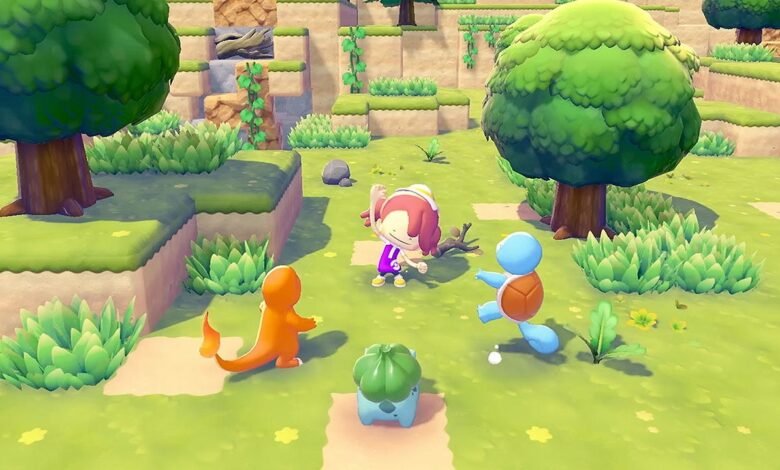
The opening tutorial is seamlessly woven into the natural flow of the game, allowing you to start exploring and influencing the world almost immediately. After meeting Professor Tangrowth and obtaining a Pokédex, you quickly befriend your first Pokémon partners. Each new friend expands your capabilities. For instance, Bulbasaur teaches the move Leafage to create tall grass, while Squirtle provides Water Gun to hydrate parched land. Charmander introduces the concept of Specialties, where you can ask Pokémon to perform specific actions, like lighting a fire. This system of learning and applying new skills is intuitive and rewarding.
To encounter more Pokémon, you must create diverse Habitats. The basic method involves using moves like Leafage to shape the environment, but you can also manipulate objects using Ditto’s Stockpile ability. Holding the collect button has Ditto comically vacuum up surrounding items, its face contorting in a manner reminiscent of The Scream. More complex habitats, like a “Boulder-shaded tall grass” for Fighting-types or a “Hydrated flower bed,” attract specific Pokémon. After a short wait, a shaking square in a habitat signals a new friend is ready to meet. A dedicated Habitat Dex tracks all your discoveries, and occasional sparkling “traces of Pokémon” provide helpful hints for creating undiscovered habitats.
This core loop of attracting Pokémon, learning from them, and then crafting new habitats to attract even more is incredibly compelling. It forms the heart of the experience, enhanced by crafting and world customization. According to Chief Director Takuto Edagawa, the development team meticulously designed this cycle of player motivation. Every step is about being with and communicating with Pokémon, a defining difference from other life-simulation games.
This cycle also integrates with the main objectives. Early on, you discover a dilapidated Pokémon Center. Its PC activates the Poke Life Environment Improvement App, which issues tasks crucial for progression, such as raising an area’s Environment Level or rebuilding structures, alongside daily goals like collecting sticks. Improving the Environment Level requires attracting more Pokémon and boosting their Comfort Levels. You can see a Pokémon’s preferred habitat zone and place requested furniture within it, crafting a Straw Bed for Bulbasaur, for example, to make them happier. Success rewards you with Life Coins to spend on furniture, recipes, and hints, while Professor Tangrowth provides further guidance.
There is clearly much more to uncover beyond these foundations. The preview didn’t fully explore building construction or the array of collectibles, such as Human Records that offer lore snippets. A four-player multiplayer session showcased a developed world where habitats evolved into proper houses, complete with furniture, plushies, and a town adorned with sidewalks and lamp posts. While my multiplayer time was brief, the potential for joyful, distraction-filled collaboration with friends is immense.
Edagawa estimates the journey to the credits will take between 20 and 40 hours, depending on play style. However, the true motivation isn’t merely to reach an ending; it’s to build a world to live in with Pokémon. The post-game will offer continued incentives to play. Producer Kanako Murata also hinted at special daily events for those who log in regularly. For players who have invested hundreds of hours into games like Animal Crossing: New Horizons, Pokopia offers a similarly deep, Pokémon-centric canvas for creativity. Personally, I’m eager to help Ditto uncover the mystery of this empty world and restore it alongside my new Pokémon friends.
(Source: IGN)