Mchose Ace 68 Gaming Keyboard Review: 16 kHz Performance
▼ Summary
– The Mchose Ace 68 Turbo is a 68-key gaming keyboard that holds the record for the fastest 16 kHz polling rate, though the practical benefit of this extreme speed is debatable for most users.
– It features high-quality Mount Tai GT HE magnetic switches, which provide a smooth, precise, and quiet typing feel due to their non-contact Hall effect design.
– The keyboard has a premium, heavy aluminum construction and a sleek design, but its software and packaging instructions are only available in Chinese, complicating setup.
– While excellent for gaming due to its fast response and customizable triggers, the review notes it is not an ideal keyboard for extensive typing or writing tasks.
– It is positioned as a more affordable alternative to other high-end magnetic switch keyboards like the Wooting 80HE, offering strong value for its performance tier.
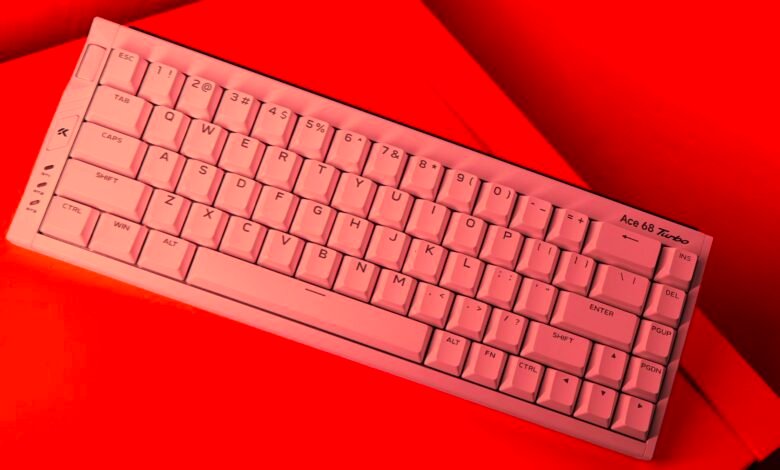
For gamers seeking the absolute pinnacle of performance, the Mchose Ace 68 Turbo keyboard makes a compelling case with its industry-leading 16 kHz polling rate and premium magnetic switches. This compact, wired peripheral promises near-instantaneous response times wrapped in a surprisingly hefty aluminum chassis. While its blistering speed is the headline feature, the overall experience is defined by sublime switch feel and a robust build, though navigating its software presents a notable hurdle for non-Chinese speakers.
Upon unboxing, the keyboard’s substantial weight is immediately apparent. Tipping the scales at 1.36 kg, it feels remarkably dense and solid on the desk, a quality attributed to its aluminum case and internal metal plate. This heft translates to excellent stability, ensuring the board stays firmly planted even during intense gaming sessions. The design language leans into a sleek, industrial aesthetic with exposed screws and a prominent RGB lightbar along the back edge.
The core attraction is the use of Mount Tai GT HE magnetic switches. These utilize the Hall effect to register key presses without physical contact, resulting in a uniquely smooth and consistent keystroke. The action is notably free of the slight grit or tactile bump found in traditional mechanical switches, offering instead a quiet, linear descent. The potential for customization is significant, with software allowing adjustment of the actuation point down to a mere 0.1 mm, enabling ultra-rapid trigger functionality favored in competitive gaming.
Achieving that headline 16 kHz polling rate, however, requires some effort. The keyboard defaults to 8 kHz, and unlocking its full speed necessitates downloading the Mchose Hub software and a firmware update. The setup process is complicated by interfaces and agreements presented only in Chinese, a barrier that extends to the included documentation. While the physical operation of the keyboard is straightforward, accessing its deepest customization features demands patience or translation tools.
In practical use, the difference made by that extreme polling rate is subtle, arguably imperceptible to most. The latency reduction amounts to fractions of a millisecond, often less than the ping in an online game. The benefit may be more psychological, the confidence of using the “fastest” equipment, or genuinely crucial for a tiny subset of elite players. Where the Ace 68 truly shines is in its overall quality. The typing experience is exceptionally smooth, the compact 68-key layout saves desk space, and a multifunction roller wheel adds convenient control.
The Mchose Ace 68 Turbo is a specialist’s tool. It delivers outstanding build quality, innovative switch technology, and a legitimate claim to top-tier performance. Yet, its value hinges on how much you prioritize that last fraction of speed, given the software hurdles and the debatable real-world impact for the average gamer. For those who demand the absolute best and don’t mind some configuration complexity, it’s a formidable contender. For others, its excellent core feel and design might be reason enough, even if the 16 kHz magic remains mostly on paper.
(Source: PC Gamer)


