PlayStation Portal: Why I Regret Waiting Two Years to Buy
▼ Summary
– The author was initially skeptical of the PlayStation Portal, seeing little value in a device that only offered remote play tethered to a powered-on PS5.
– Key software updates by 2026 transformed the Portal into a capable cloud streaming machine, allowing gameplay without the PS5 being on.
– Cloud streaming via PS Plus Premium, especially for retro games, has become the author’s preferred way to use the device and significantly increased its utility.
– The device has notable drawbacks, including a battery life often under five hours and a build quality that feels somewhat cheap and fragile.
– Despite its flaws, ongoing improvements have made the PlayStation Portal a highly valued and frequently used gaming accessory for the author.
Looking back, my initial hesitation about the PlayStation Portal seems almost laughable now. What I once dismissed as a niche gadget has become an indispensable part of my gaming routine, and I genuinely regret not buying it sooner. The key transformation came not from the hardware itself, but from a series of software updates that fundamentally redefined its purpose. The most significant change is the full integration of cloud streaming via PS Plus Premium, which liberates the device from its original tether to a powered-on PS5. This single feature shifted the Portal from a convenient remote play accessory into a legitimate standalone cloud gaming machine, massively expanding its utility and value.
My skepticism was rooted in the original premise. Why would I need a dedicated screen to play my PS5 in another room when I could just walk over and turn on the television? For standard remote play, that feeling persists, it’s a pleasant luxury for lounging on the sofa, but not a revolution. The connection is generally stable, though the system dashboard can appear slightly soft. The real magic happens when you disconnect from your console entirely and dive into the cloud.
Streaming directly from the PS Plus game catalog or my owned library has been a revelation. There’s a particular joy in experiencing classic titles on a dedicated handheld. Playing a crisp, responsive version of Soul Calibur 3 or tearing through Ridge Racer Type 4 on the Portal’s vibrant screen feels perfectly suited to the format, far more so than stretching those pixels across a massive 4K display. It’s not just about nostalgia, either. Diving into recent updates for games like Gran Turismo 7 for quick sessions has seamlessly integrated gaming into moments of downtime throughout my day.
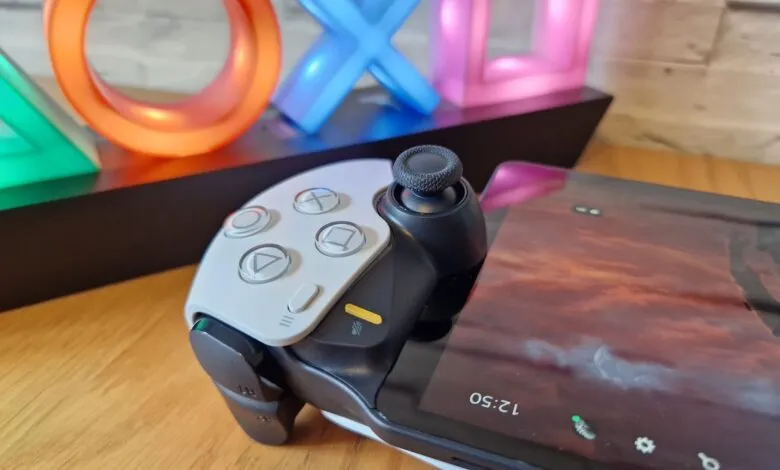
While cloud streaming technology has improved markedly, it isn’t flawless. Visual quality can fluctuate, and I experienced one complete dropout during a session. However, for the vast majority of my playtime, the experience has been reliably smooth. The hardware itself presents a mixed bag. The Portal is surprisingly comfortable to hold for extended periods, yet its construction undeniably feels like a DualSense controller with a screen inserted in the middle. It doesn’t inspire confidence in its durability. The other major drawback is battery life. Much like the standard DualSense, it struggles to provide a truly lengthy charge, typically requiring a plug after four to five hours of use depending on game demands and settings.
Despite these compromises, the device’s evolution has won me over. Sony’s continued support, in stark contrast to other peripherals, has paid off. The Portal today is a far more compelling product than the one launched in 2023. Its ability to function as both a remote play extension and a capable cloud streamer has cemented its place in my gaming arsenal. As the library of streamable classics grows, my only real regret is the two years of potential portable play I missed out on by waiting.
(Source: techradar)