Final Fantasy 9 Defined the Series 25 Years Ago
▼ Summary
– Long-running gaming series like Final Fantasy face challenges in staying relevant while maintaining their core identity, often by avoiding predictable paths.
– Final Fantasy 9, celebrating its 25th anniversary, solidified the series’ identity by prioritizing storytelling and authenticity over trends.
– The game begins with a lighthearted fantasy setup but evolves into a complex plot involving political intrigue, ancient civilizations, and existential threats.
– Unlike its sci-fi predecessors (FF7 and FF8), FF9 returned to medieval fantasy, initially perceived as childish but ultimately showcasing the series’ versatility.
– FF9 embraced innovation (e.g., ATE system) and challenged expectations, proving the series thrives by reinventing itself rather than repeating formulas.
Few gaming franchises have endured as successfully as Final Fantasy, maintaining relevance across decades while constantly reinventing itself. Celebrating its 25th anniversary, Final Fantasy IX stands out as the installment that distilled the essence of what makes the series special, bold storytelling, memorable characters, and a willingness to defy expectations.
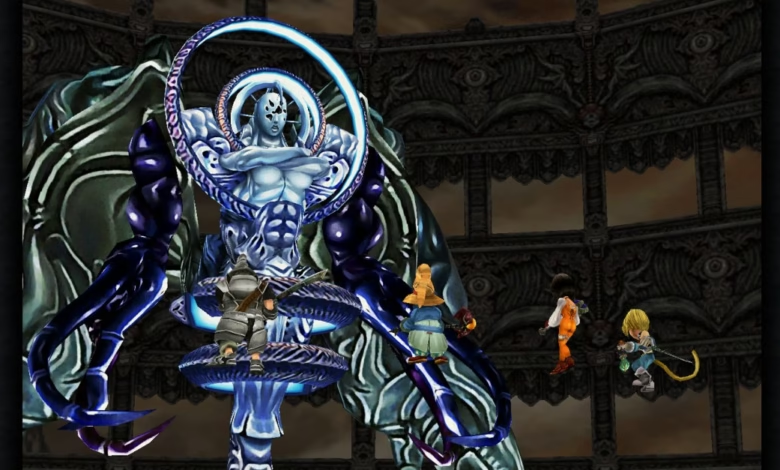
The game opens with a playful, almost theatrical introduction. In the kingdom of Alexandria, a princess named Garnet attempts to flee her own castle, unknowingly crossing paths with Zidane, a thief disguised as an actor. Meanwhile, the rigid knight Steiner scrambles to protect her, unaware she wants to escape. Thrown into the chaos is Vivi, a young boy evading guards after sneaking into the festivities. What begins as a lighthearted farce soon spirals into an epic tale of political intrigue, ancient civilizations, and a battle against existential darkness.
What sets Final Fantasy IX apart is its deliberate return to classic fantasy tropes after the sci-fi leanings of its predecessors. Final Fantasy VII and VIII had embraced futuristic settings, leading some to assume the series was abandoning its medieval roots. By contrast, IX’s whimsical art style and traditional fantasy elements initially gave the impression of a simpler, more childlike adventure, until its narrative depth became undeniable.
Rather than replicating Final Fantasy VII’s success, the developers chose to redefine the series’ identity. As character designer Toshiyuki Itahana recalled, the team aimed to capture the “magic that stays with you to the very end.” This philosophy aligned with creator Hironobu Sakaguchi’s vision, pushing boundaries while keeping storytelling at the core.
Technologically, Final Fantasy IX was no step backward. It introduced the Active Time Event system, allowing players to glimpse parallel storylines unfolding elsewhere in the world. The game also showcased the PlayStation’s capabilities with stunning pre-rendered cutscenes, proving that a return to tradition didn’t mean sacrificing innovation.
In the end, Final Fantasy IX succeeded by embracing what made the series beloved while refusing to play it safe. Its legacy lies in proving that fantasy, when crafted with heart and ambition, can resonate just as powerfully as any futuristic epic.
(Source: Polygon)