How Two Nissan Leafs Power a Regional Airport’s Resilience
▼ Summary
– Electric vehicles are more energy-efficient than gas cars and offset their battery production energy within one to two years.
– EVs offer benefits like quiet operation, ease of driving, and the ability to power a house in emergencies.
– Redwood Coast Airport in Humboldt County uses a microgrid with bidirectional charging and Nissan Leaf EVs for its operations.
– The airport’s microgrid includes solar arrays and battery storage, enabling it to operate independently during power outages.
– The second-generation Nissan Leaf supports vehicle-to-grid technology, now being utilized in a North American pilot project.
The future of energy resilience is taking flight in an unexpected place, powered by a familiar electric vehicle. At California’s Redwood Coast Airport in Humboldt County, a forward-thinking microgrid now incorporates bidirectional charging from two Nissan Leaf electric cars, enhancing the facility’s ability to operate independently during power disruptions. This setup demonstrates a practical application of vehicle-to-grid (V2G) technology, turning parked EVs into valuable energy assets rather than just transportation.
Since 2021, the airport’s microgrid has relied on a combination of a 2.2 megawatt solar array, an 8.9 megawatt-hour battery storage system, and a 300 kilowatt net-metered solar installation. Under normal conditions, this system can send surplus electricity back to the local utility grid operated by PG&E. However, when outages occur, the microgrid seamlessly disconnects, allowing the airport to maintain critical operations using its stored and generated power.
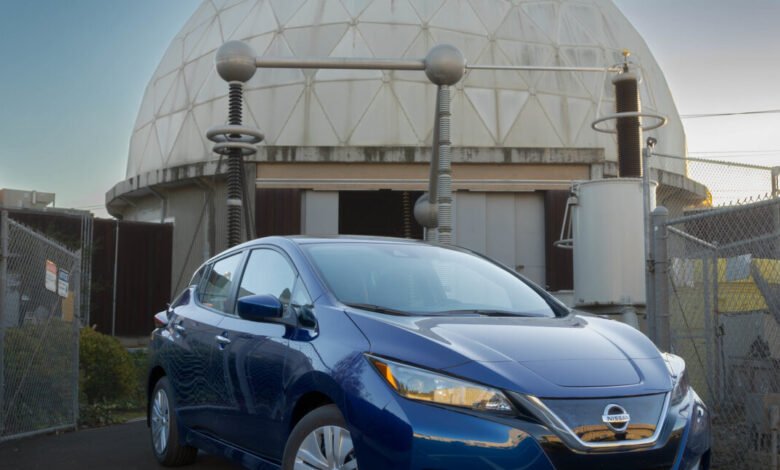
Adding the Nissan Leafs to this equation marks a significant evolution. One of the vehicles is a 2021 model purchased by the Humboldt County Aviation Division, while the other is a 2020 model supplied by Nissan. These are previous-generation Leaf models, which continue to use the CHAdeMO standard for DC fast charging. While this generation of the Leaf has always possessed V2G capability, North America had not seen a pilot program implement it, until now.
This project places the Nissan Leaf alongside other vehicles like electric school buses and the Ford F-150 Lightning in the growing V2G movement. It’s a meaningful step, proving that even as newer models arrive, existing EVs can still play a crucial role in supporting community energy infrastructure. The initiative highlights how everyday electric cars can contribute to regional energy security and grid stability, offering a glimpse into a more integrated and resilient energy future.
(Source: Ars Technica)