Inside GM’s Lab: The Race to Build Better EV Batteries
▼ Summary
– GM is rigorously testing EV batteries in advanced labs, simulating 10 years of real-world use in just six months through extreme environmental and stress testing.
– The company attributes a $1.6 billion loss to Trump administration policies that eliminated EV credits and loosened emissions rules, impacting consumer demand and production plans.
– GM is developing lithium manganese rich (LMR) batteries, promising 400+ miles of range at lower costs and aiming to outperform China’s dominant lithium iron phosphate (LFP) technology by 2028.
– The automaker is investing billions in US battery operations and in-house development to accelerate innovation, reduce production time, and cut costs by using cheaper materials like manganese.
– Despite policy headwinds, GM is subsidizing EV purchases to maintain sales and believes achieving price parity with gasoline vehicles will make EVs the superior choice for consumers.
Deep within General Motors’ rapidly expanding battery research facilities near Detroit, teams of scientists and engineers are subjecting lithium-ion cells to extreme conditions. These rigorous tests simulate everything from scorching desert temperatures to frigid arctic cold, high humidity environments, and repeated charge cycles that would push any battery to its absolute limits.
During an exclusive facility tour, observers witnessed researchers examining cell chemistries at the atomic level using advanced electron microscopes. Meanwhile, in a massive testing chamber, technicians operated the imposing Megashaker apparatus. This specialized equipment subjects GM’s double-stacked 205-kilowatt-hour battery packs, the kind that power substantial vehicles like the Cadillac Escalade IQ, to intense vibrational stresses.
The 2,900-pound battery assembly hangs suspended from ceiling-mounted cranes, securely fastened to simulate its mounting in an actual vehicle. Inside the climate-controlled chamber, hydraulic systems shake the battery unit vigorously, replicating everything from rough road surfaces to minor collision impacts. With numerous testing chambers dedicated to individual cells, modules, and complete packs, GM can effectively compress a decade and 250,000 miles of real-world battery usage into approximately six months of accelerated testing.
The current automotive landscape presents significant challenges for electric vehicles. Consumer enthusiasm has cooled somewhat, partly due to persistently high pricing. Regulatory shifts have created additional headwinds, with the elimination of the popular $7,500 federal clean-car credits delivering a substantial blow to automakers. GM recently reported a $1.6 billion financial impact directly tied to these policy changes and relaxed emissions standards.
Despite these market pressures, GM maintains its commitment to electric vehicle development. At the company’s historic Technical Center, the iconic midcentury campus designed by architect Eero Saarinen, engineers are advancing what they believe could be a game-changing technology: lithium manganese rich batteries, commonly called LMR.
Some industry observers question whether traditional Detroit automakers can effectively compete with China’s dominant position in the global EV market. GM’s technical leadership remains confident, asserting that their affordable, sustainable LMR batteries will significantly outperform China’s preferred lithium iron phosphate cells, known as LFP.
The company projects its new cell technology will deliver approximately one-third more driving range than LFP batteries at nearly identical cost. This performance differential could mean the distinction between an EV achieving 300 miles per charge versus one capable of 400 miles or more. GM anticipates its largest SUVs and pickup trucks will achieve EPA-rated ranges exceeding 400 miles when these batteries launch in 2028. The new technology is also expected to reduce battery pack costs by at least $6,000 compared to current high-nickel designs.
“This unlocks premium long-distance range at an affordable cost,” explains Andy Oury, a principal battery engineer at GM.
Kurt Kelty, GM’s vice president of battery, propulsion, and sustainability, brings considerable expertise from his previous role guiding battery development at Tesla. He emphasizes that LMR technology differs from many laboratory promises that never reach production.
“I’ve seen numerous technologies emerge and disappear throughout my career,” Kelty notes. “When I describe this as a game-changing development, it’s based on extensive experience witnessing what actually progresses from concept to commercialization.”
Where many battery improvements represent marginal gains, Kelty characterizes LMR cells as representing a substantial advancement without the typical performance trade-offs. “Typically, achieving high energy density compromises cycle life or increases cost,” he observes. “In this instance, we’ve developed a remarkably balanced chemistry.”
These batteries could also help reduce dependence on Chinese supply chains by utilizing more North American resources. Regarding China’s current market dominance, Kelty acknowledges the competitive landscape while noting the irony that LFP technology originated from University of Texas research before being widely adopted by Chinese manufacturers.
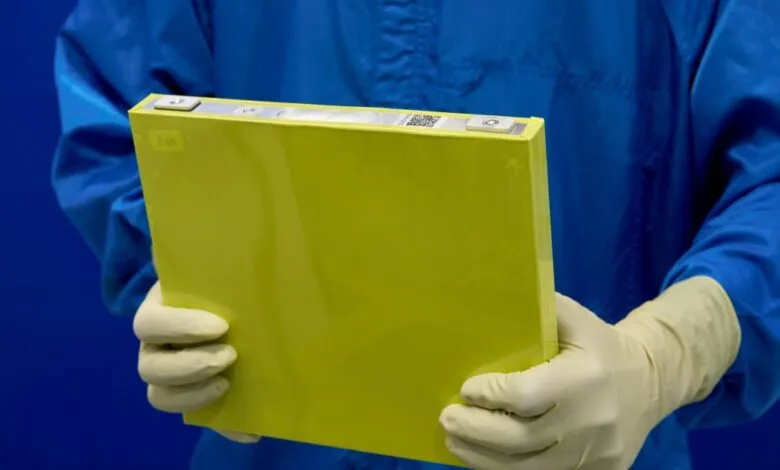
Oury indicates that LMR chemistry has existed conceptually for about ten years, but previous iterations struggled with voltage degradation over time. GM intensified development efforts five years ago, beginning with coin-sized cells and progressively addressing durability concerns while scaling up to larger prismatic formats suitable for automotive applications.
Among North American manufacturers, GM made early commitments to developing proprietary high-nickel battery technology. The NCM chemistry, comprising nickel, cobalt, and manganese, offers superior energy density and currently powers most electric vehicles sold in the United States. After initial manufacturing challenges, GM has become the largest producer of lithium-ion cells in North America through partnerships with LG Energy Solution.
While high-nickel formulations excel at delivering extended range, they carry significant cost burdens due to expensive nickel and cobalt content. Cobalt sourcing presents additional ethical concerns, with some extraction occurring in regions employing child labor. These material expenses contribute substantially to overall vehicle costs, explaining why premium EVs like Cadillac’s 615-horsepower Lyriq-V start above $81,000.
China addressed cost concerns through LFP batteries, which utilize inexpensive, abundant iron and phosphate while eliminating cobalt entirely. The compromise comes in the form of reduced energy density and performance compared to high-nickel alternatives.
LMR technology strikes a middle path by incorporating substantial manganese content. This abundant silver-gray transition metal enables performance approaching high-nickel designs while potentially achieving significantly lower costs than LFP alternatives. Ford Motor Company has also announced progress with similar manganese-rich battery chemistry.
In this chemical competition, the primary action occurs at the cathode, the positive electrode that generates electricity during discharge. Contemporary NCM batteries typically contain approximately 85% nickel, 10% manganese, and 5% cobalt in their cathodes. LMR formulations substantially alter this balance, incorporating up to 70% manganese, around 30% nickel, and 2% or less cobalt.
“Manganese is extremely inexpensive, providing immediate raw material advantages,” states Kushal Narayanaswamy, GM’s director of advanced battery cell engineering.
Beyond material savings, GM’s integrated approach to battery development could significantly accelerate innovation cycles. The company’s Wallace Battery Cell Innovation Center enables rapid prototyping and testing without constant coordination with external suppliers. The facility currently produces up to 100 test cells daily and has created 26 distinct LMR variants across three form factors.
Adjacent to this facility, the Ancker-Johnson Battery Cell Development Center will house pilot assembly lines bridging the gap between laboratory research and full-scale manufacturing. GM has reduced battery testing duration by 60% through extensive digital simulation, creating virtual models that replicate countless real-world scenarios before physical prototyping.
With government incentives diminishing, GM has temporarily assumed the $7,500 credit amount through subsidized leasing arrangements to maintain sales momentum. This approach provides customer benefits while impacting corporate profitability, particularly when combined with substantial tariff expenses.
When questioned about the subsidy reduction, Kelty reflects: “Would we have preferred a more gradual transition? Certainly. However, this situation compels us toward necessary efficiency improvements. We must reduce costs to compete effectively without relying on external support.”
He notes that electric vehicles already compete favorably with internal combustion vehicles in total ownership costs, though many consumers remain focused on initial purchase price. “When we achieve comparable sticker prices, internal combustion engines will face serious challenges across most applications,” Kelty predicts. “The driving experience with electric vehicles is simply superior.”
(Source: The Verge)