The Reality of Space Dogfighting: One Company’s Mission
▼ Summary
– Future space battles will be slow, strategic, and cerebral, unlike the fast-paced dogfights depicted in science fiction, more akin to a meticulous political thriller.
– The startup True Anomaly is developing a satellite platform named Jackal, designed for mass production and readiness for potential orbital warfare.
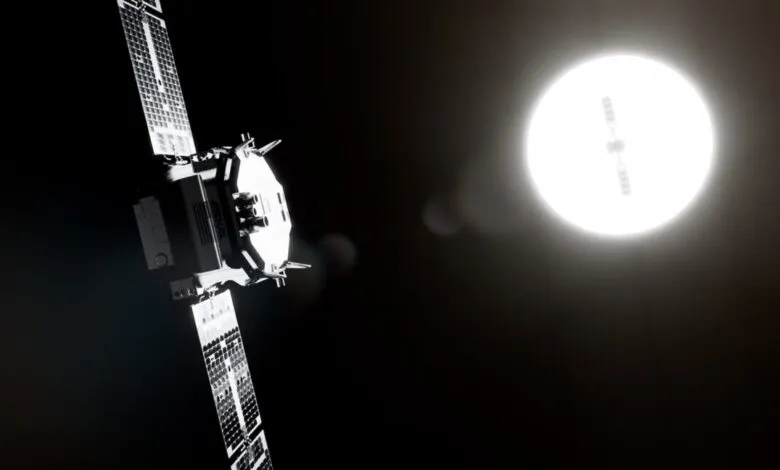
– The Jackal spacecraft is agile and maneuverable, essentially a flying fuel tank with thrusters and sensors for approaching and surveilling objects in orbit.
– True Anomaly, founded in 2022 by a former Air Force officer, has launched several test missions and has attracted hundreds of millions in investment.
– The company, named after an orbital mechanics term, has grown to several hundred employees and is positioned for a significant expansion.
The future of conflict in orbit will likely unfold with a deliberate, chess-like precision, a stark contrast to the frenetic dogfights of science fiction. Rather than swift exchanges of laser fire, space battles are expected to be protracted contests of positioning, intelligence, and maneuverability, measured over weeks or months. This strategic reality is driving the development of new technologies designed for orbital vigilance and control, where the ability to observe and outmaneuver an adversary is paramount.
One company actively preparing for this environment is True Anomaly. Founded in 2022, the startup has developed a satellite platform named Jackal, a system built for agility and mass production. The name is fitting; much like the cunning canine, the spacecraft is designed to be an intelligent and adaptable hunter in the orbital domain. The company itself takes its name from a precise term in orbital mechanics, reflecting its focus on the detailed physics of space operations.
The Jackal spacecraft is essentially a highly maneuverable flying fuel tank, roughly the size of a refrigerator. Its design prioritizes the capability to rapidly change orientation, approach other objects, and conduct close surveillance. This agility is the cornerstone of its potential role in future space security missions, where the simple act of closely observing another satellite can be a powerful strategic tool. True Anomaly has already launched three test missions for the Jackal platform, with a fourth planned in the coming months.
The company’s vision extends beyond observation. Co-founder Even Rogers, a former Air Force space operations officer, believes platforms like Jackal could eventually be utilized for orbital combat, a scenario where control of position and movement would be decisive. This long-term vision has attracted significant investment, propelling the company’s growth to a workforce of several hundred. The strategic shift in space, moving from a sanctuary to a potential arena of competition, is creating demand for the specialized capabilities True Anomaly is engineering. Their work represents a tangible step toward a new era of space operations, where patience and precision may prove far more valuable than speed and spectacle.
(Source: Ars Technica)