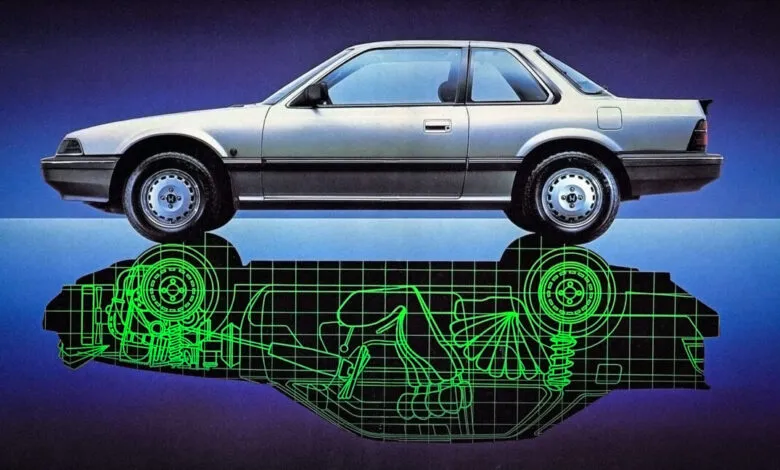
Honda Prelude: The Engineering Thesis Disguised as a Coupe
▼ Summary
– The Honda Prelude was an engineering-focused coupe that embodied Honda’s commitment to precision and clever, accessible design.
– Its 2026 revival represents a return to the name’s core values of balance, innovation, and mechanical elegance over market trends.
– The original Prelude was born in a period of significant economic and industry turbulence, which shaped its deliberate character.
– Key global economic shocks in the early 1970s, including the end of the Bretton Woods system and the OPEC oil crisis, created major challenges for Honda.
– Honda’s founders stepped down during this instability, leaving a large, exposed company to navigate these heightened financial stakes.
The upcoming return of the Honda Prelude represents far more than a nostalgic revival; it is a strategic reassertion of a core automotive philosophy. This model has always stood for a specific set of principles: balance over brute force, innovation over ornament, and a relentless pursuit of mechanical elegance. As the automotive landscape shifts toward electrification and digital interfaces, the Prelude’s legacy of disciplined engineering and driver-focused design becomes profoundly relevant. Its comeback signals Honda’s commitment to these enduring values in a new technological era.
The original Prelude was born from necessity, not luxury. It debuted during a period of severe global economic instability, a time when constraint defined creativity. The early 1970s presented a perfect storm for automakers, particularly those like Honda with deep ties to international trade. President Richard Nixon’s decision to untether the dollar from gold in 1971 triggered a chain reaction, leading to a formal devaluation by 1973. Fixed exchange rates vanished, causing the Japanese yen to surge in value. This made Japan’s exports, including its cars, suddenly more expensive in crucial markets like the United States.
Corporate forecasts were rendered obsolete almost overnight. The situation grew even more dire with the OPEC oil embargo in October 1973. Production cuts sent fuel prices skyrocketing, injecting fresh panic into the global economy and threatening consumer demand for automobiles. For Honda, which relied on the U.S. for roughly sixty percent of its sales, the business calculus changed completely. A stronger yen compressed profit margins, while soaring gas prices placed question marks over future sales volumes. The entire Japanese export model appeared vulnerable.
It was at this precise moment of profound uncertainty that the company’s legendary founders, Soichiro Honda and Takeo Fujisawa, chose to retire from the firm they had built from the ground up. Their departure marked the end of an era. Honda was no longer a plucky startup; it was a major corporation with thousands of employees and significant capital. Yet this scale offered no protection from the crisis, it only magnified the risks. The stage was set for a new chapter, one that would require intelligent adaptation and resilient engineering. The answer, in part, would be a compact, technically brilliant coupe conceived not in a time of plenty, but in a crucible of challenge.
(Source: Ars Technica)