Jeff Bezos’ Blue Origin Plans New Megaconstellation
▼ Summary
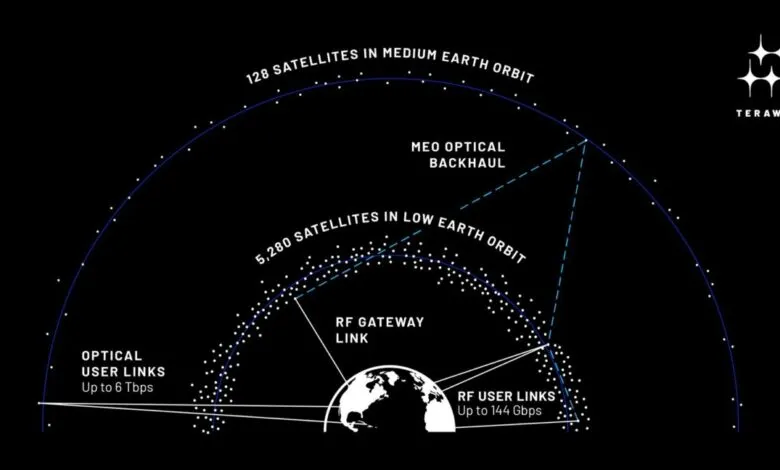
– Blue Origin announced a new satellite constellation called TeraWave, which will consist of 5,408 interconnected satellites in low and medium Earth orbit.
– The system is designed to deliver extremely high data speeds up to 6Tbps globally, focusing on reliability and resilience for critical operations.
– Unlike competitors like Starlink, TeraWave will target enterprise, data center, and government users, not consumers or direct-to-cell services.
– The announcement was surprising because Jeff Bezos’s Amazon is already developing its own competing megaconstellation, Amazon Leo.
– Blue Origin’s move appears driven by the growing data demands from AI and other enterprise sectors, creating a new competitive area for lucrative customers.
The recent announcement from Blue Origin, the aerospace company founded by Jeff Bezos, reveals a major new venture into satellite communications. The project, named TeraWave, is a planned megaconstellation designed to deliver exceptionally high-speed data connectivity across the globe. This system aims to provide data speeds reaching up to 6 terabits per second through a network of 5,408 satellites. Most of these satellites will operate in low-Earth orbit, with the remainder positioned in medium-Earth orbit, creating a layered and robust infrastructure.
This constellation is engineered for maximum performance and reliability. Satellites in the lower orbit will utilize radio spectrum to offer speeds up to 144 gigabits per second. Those stationed higher up will employ optical inter-satellite links to achieve even greater data rates. Blue Origin CEO Dave Limp emphasized the system’s core advantages on social media, stating it delivers the resilience necessary for real-time operations and moving massive amounts of information. He highlighted its role in providing backup connectivity during service outages to keep critical functions online, along with the ability to scale capacity on demand and deploy services rapidly anywhere in the world.
A key differentiator for TeraWave is its target market. Unlike other large satellite networks such as SpaceX’s Starlink, Blue Origin’s system will not target consumer internet users or pursue direct-to-cell phone services. Instead, the company is squarely focusing on the enterprise sector. The constellation is intended to serve what it describes as “tens of thousands” of major clients, including large corporations, data center operators, and government agencies. These users require ultra-reliable, high-bandwidth connections for mission-critical operations where downtime is not an option.
The unveiling of TeraWave was notable for several strategic reasons. It was unexpected because Bezos’s other corporate giant, Amazon, has been developing its own competing satellite internet project for over five years. That system, now called Amazon Leo, has regulatory approval to launch 3,236 satellites into low-Earth orbit. Amazon’s project is widely seen as a direct competitor to Starlink, aiming to provide services like in-flight Wi-Fi and consumer broadband.
The decision for Blue Origin to launch a separate, enterprise-focused constellation suggests a calculated business move. It appears the soaring data demands driven by artificial intelligence data centers and other large-scale digital operations have created a substantial new market. Bezos likely sees a lucrative opportunity for Blue Origin to capture enterprise customers seeking dedicated, high-performance space-based connectivity. This positions TeraWave to operate in a similar premium sector where Amazon Leo is also expected to compete, indicating a broader corporate strategy to dominate multiple tiers of the satellite connectivity market.
(Source: Ars Technica)