How China’s ‘Crystal Capital’ Dominates the Global Market
▼ Summary
– Chinese villages like Xuchang and Zhuangzhai specialized in global market niches, such as wigs and caskets, based on local resources and opportunities.
– Donghai leveraged its quartz, labor, and entrepreneurial innovation, like modifying washing machines for polishing, to become a crystal hub despite material shortages.
– Illegal mining in Donghai caused safety issues, prompting a crackdown and forcing local entrepreneurs to seek crystal sources internationally.
– Donghai traders, displaying a confident, global mindset, discovered abundant quartz deposits in countries like Madagascar and Zambia, where it was as common as coal.
– Entrepreneurs like Liu from Donghai traveled worldwide, such as to Brazil and Uruguay, to source materials like amethyst, adapting their strategies based on market findings.
Nestled within China’s vast manufacturing landscape, specialized towns have carved out remarkable global niches by focusing on single products. From wigs in Xuchang to caskets in Zhuangzhai and buttons in Qiaotou, these communities transformed local resources or simple opportunities into worldwide dominance. The story of Donghai County, however, stands apart, revealing how a combination of raw material, relentless innovation, and global ambition forged the world’s undisputed crystal capital.
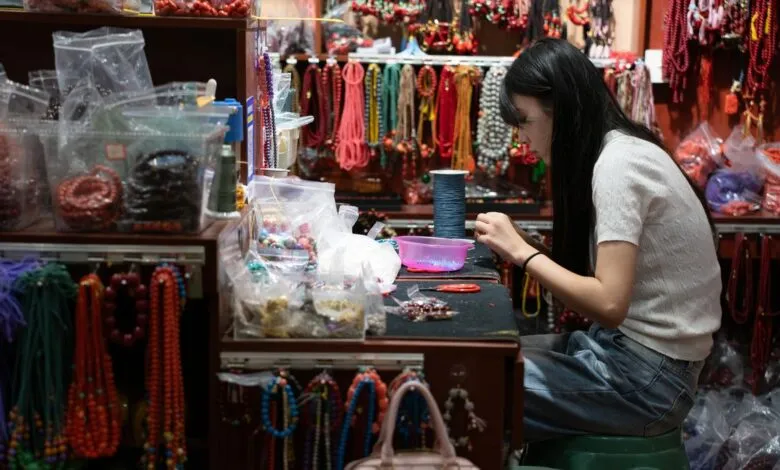
Donghai possessed a natural advantage with its quartz deposits and a deep pool of skilled artisans. Yet its rise was fueled by a pragmatic, problem-solving spirit. When demand for polished crystal necklaces surged in the late 1980s, local entrepreneurs ingeniously modified washing machine motors to automate the painstaking manual polishing process. Faced with severe shortages of raw crystal, manufacturers demonstrated incredible adaptability, even resorting to melting down beer bottles to create beads. This scarcity became so intense that residents recall local bars and restaurants temporarily running out of beer.
Environmental and regulatory pressures soon forced another pivotal shift. Rampant illegal mining led to dangerous sinkholes and collapsing infrastructure, prompting a government crackdown around 2001. With domestic supplies tightening, Donghai’s businesspeople looked far beyond their borders. A new era began as traders fanned out across the globe in search of raw material, embodying a philosophy that wherever quartz could be found, someone from Donghai would soon arrive.
This outward push was driven by a profound sense of entrepreneurial confidence. Specialists note that for these determined individuals, cultural and geographic barriers were not seen as insurmountable obstacles but simply as logistical challenges to be overcome through sheer effort. Their perseverance was quickly rewarded with astonishing discoveries. Traders learned of massive, untapped quartz deposits in Africa, sometimes so abundant that the material was used for road gravel. Compared to Donghai’s scattered veins, entire mountains of rose quartz in countries like Madagascar and Zambia represented a staggering new scale of opportunity.
This global quest is personal for entrepreneurs like Liu, owner of Big Purple Crystal. His journey began a decade ago with a cheap ticket to Brazil and a translator in tow, resulting in the immediate purchase of a twenty-ton container of goods. When that venture proved difficult, he continued searching, eventually finding his niche after encountering magnificent amethyst from Uruguay at a major gem show in Arizona. His story mirrors the broader narrative: a relentless drive to source the best materials from every corner of the planet, ensuring Donghai’s finished products maintain their grip on the international market.
(Source: Wired)