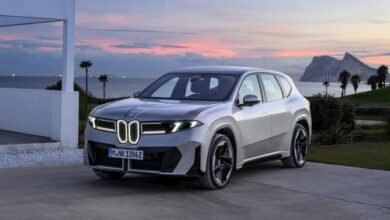
Kia EV2: Europe’s Most Affordable Electric Car

▼ Summary
– Kia unveiled the EV2, a compact and affordable electric vehicle designed for the European market, at the Brussels Auto Show.
– The EV2 will be offered in two trims: a Standard-range version with 197 miles of range and a Long-range version with 273 miles of range.
– It features a 400-volt architecture with a 30-minute fast charge time and supports AC charging, bidirectional charging, and advanced driver-assistance systems (ADAS).
– Production for the standard model is scheduled to begin in Slovakia in February 2026, with longer-range and GT trims following in June 2026.
– The EV2 is not planned for sale in the US, partly due to American market preferences, despite its estimated attractive price of around $20,000.
Kia has officially introduced the EV2, positioning it as a compelling new entry in the affordable electric vehicle segment for European drivers. The compact model debuted at the Brussels Auto Show, where the automaker emphasized its role as the brand’s most accessible and smallest EV offering. This launch arrives amidst a growing field of budget-friendly electric options across Europe, presenting both opportunity and competitive challenges for Kia’s market strategy.
The vehicle will be offered in two primary configurations. The Standard-range model features a 42.2kWh battery, delivering an estimated 317 km (197 miles) of range on the WLTP cycle. For those seeking extended driving distance, the Long-range trim is equipped with a larger 61kWh battery pack, providing over 440 km (273 miles) of range. Performance varies slightly between the two; the standard version accelerates from 0-100 km/h in 8.7 seconds, while the long-range model completes the same sprint in 9.5 seconds.
Visually, the EV2 adopts a clean, modern aesthetic with sharp lines and upright proportions. Its design language includes distinctive LED daytime running lights at the front and rear, aligning with Kia’s contemporary styling philosophy. Within the brand’s electric lineup, it will sit below the upcoming EV3 and EV4 models. To maintain an affordable price point, Kia developed the EV2 on a modified, cost-effective version of the Hyundai Motor Group’s Electric Global Modular Platform (E-GMP).
This engineering choice means the EV2 utilizes a 400-volt electrical architecture rather than the faster-charging 800-volt systems found in models like the EV6 and EV9. Kia states both battery variants can recharge from 10 to 80 percent in approximately 30 minutes using DC fast charging. In a strategic move for the European market, the EV2 will be the first Kia to support both 11kW and 22kW AC charging, accommodating the prevalent charging infrastructure. The vehicle also incorporates bidirectional charging capabilities, enabling vehicle-to-load and vehicle-to-grid functionality.
Despite its focus on affordability, the EV2 is not devoid of modern technology. Kia plans to equip it with an array of advanced driver-assistance systems (ADAS). These features are expected to include adaptive cruise control, automatic emergency braking, and a remote smart parking assist function, allowing drivers to maneuver the car into tight spaces using the key fob from outside the vehicle.
Production is slated to begin in February 2026 at Kia’s manufacturing facility in Slovakia, starting with the standard-range version. The long-range and any potential performance-oriented GT trims are scheduled to follow in June of the same year. With an estimated starting price around $20,000, the EV2 represents a significant value proposition. However, current plans indicate it will remain a Europe-exclusive model, partly due to differing market demands. The apparent preference among American consumers for larger vehicles suggests this particular compact, budget-friendly EV is unlikely to be offered in the United States, at least in the immediate future.
(Source: The Verge)