Phison’s 2.3W SSD Controller Solves PCIe 5.0 Power Drain
▼ Summary
– Phison’s new PS5037-E37T PCIe 5.0 SSD controller prioritizes power efficiency and affordability for compact devices while delivering impressive speeds, including up to 14.7 GB/s reads.
– The E37T controller uses a 6nm process and DRAM-less architecture, achieving a 38% performance boost over previous PCIe 5.0 DRAM-less controllers and maintaining low active power below 2.3W.
– At CES 2026, an E37T prototype demonstrated even higher performance than claimed, with read speeds over 14,900 MB/s and a low power draw of just 2.13W.
– Phison also announced upcoming 8TB SSDs using its flagship E28 controller, which demonstrated exceptional performance in prototypes, though they will initially be expensive due to high demand and NAND shortages.
– Both the E37T and E28 controllers reinforce Phison’s industry leadership, with the E37T enabling efficient storage for laptops and handhelds and the E28 pushing high-capacity, high-performance SSD boundaries.
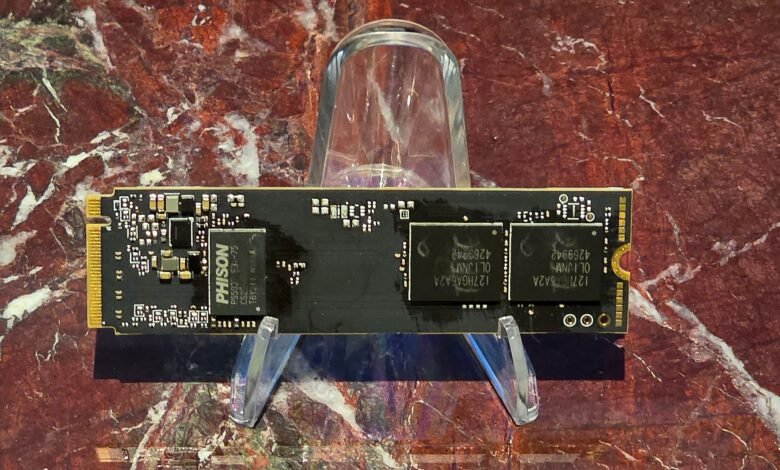
Phison’s latest SSD controller is poised to transform storage for portable devices by tackling one of PCIe 5.0’s biggest challenges: excessive power consumption. The new PS5037-E37T controller delivers exceptional speed while operating at an impressively low power draw, making it a game-changer for laptops and gaming handhelds where battery life and thermal management are critical.
This new controller represents a strategic shift from the raw performance focus of Phison’s flagship E28 model. Instead, the E37T is engineered for exceptional power efficiency and affordability, without making major compromises on speed. Built on TSMC’s advanced 6nm process, it utilizes a sophisticated DRAM-less architecture and supports four NAND channels. This design provides a substantial 38% performance increase over prior DRAM-less PCIe 5.0 controllers and enables impressive transfer rates.
The controller achieves sequential read speeds up to 14.7 GB/s and write speeds up to 13 GB/s, all with an active power consumption below 2.3W. Its random performance is also robust, rated for up to two million IOPS. When stacked against the high-end E28, the E37T shows nearly identical sequential read performance and only a slight dip in writes. The more noticeable difference is in random performance, where the E37T trails by roughly a quarter in reads and a third in writes. Yet, its overall balance of speed, efficiency, and cost is what sets it apart.
A live demonstration at CES 2026 showcased the E37T prototype exceeding even Phison’s own claims. It recorded sequential read speeds over 14.9 GB/s and write speeds above 13.1 GB/s, while drawing a mere 2.13 watts. Under a demanding benchmark load, power consumption peaked at a still-manageable 4.47W, proving its real-world efficiency.
Drives using the E37T controller will soon be available in multiple compact form factors, including M.2 2280, 2242, and the tiny 2230 size. This versatility ensures it can fit into the slimmest laptops and most portable gaming consoles, bringing high-performance, energy-efficient storage to a broader range of devices.
While the E37T made headlines, Phison also revealed significant news for performance enthusiasts: its flagship E28 controller is gaining support for 8TB capacities. This development places Phison in direct competition with the few existing 8TB PCIe 5.0 drives on the market. A prototype demonstrated staggering speeds, blowing past official specifications with reads near 14.9 GB/s and writes exceeding 14 GB/s.
The primary obstacle for these high-capacity E28 drives is the current market climate. A global NAND shortage, fueled in part by massive demand from AI applications, has driven memory and SSD prices upward. Consequently, the initial cost of an 8TB PCIe 5.0 SSD will be significant, likely placing it out of reach for average consumers in the short term. However, as market pressures eventually ease and the AI frenzy stabilizes, prices are expected to normalize. This will pave the way for these powerful, high-capacity drives to become more accessible, offering unprecedented storage performance for demanding users.
(Source: Tom’s Hardware)


