The 10 Fastest Motorcycles of the 1970s Ranked
▼ Summary
– The 1970 Clean Air Act’s emission standards made large two-stroke motorcycles largely obsolete due to their polluting fuel-and-oil combustion.
– Four-stroke engines became the industry’s solution, despite two-strokes historically offering superior power-to-weight ratios and dominating racing.
– Contrary to expectations, motorcycle top speeds increased in the 1970s, building on the 1969 Honda CB750’s four-stroke 125 mph benchmark.
– The decade saw the rise of the liter-bike category and advanced aerodynamics, leading to significantly higher performance.
– One notable achievement was a motorcycle breaking the 150 mph barrier, and ten 1970s models surpassed the speed of the 1969 CB750.
The 1970s stand as a pivotal decade in motorcycle history, defined by a dramatic shift in engineering philosophy. New environmental regulations, most notably the 1970 Clean Air Act, effectively spelled the end for large-capacity two-stroke engines in mainstream production. These engines, while celebrated for their high power-to-weight ratio, burned a mixture of fuel and oil, making them incompatible with emerging emission standards. The industry’s solution was a decisive pivot toward four-stroke technology, setting the stage for a new era of performance.
Contrary to what one might expect, this regulatory shift did not slow motorcycles down. In fact, the seventies ushered in unprecedented speed. The benchmark set by the 1969 Honda CB750, a 125 mph top speed from its 736cc four-stroke engine, was quickly rendered obsolete. This decade truly birthed the modern liter-bike category and saw manufacturers begin to seriously consider aerodynamics, resulting in machines with significantly higher terminal velocities.
The progress was remarkable, with one model even shattering the 150 mph barrier. The ten motorcycles listed here, each faster than that groundbreaking Honda, represent the pinnacle of 1970s speed. They range from unconventional rotary-engine experiments to refined six-cylinder grand tourers, showcasing the diverse engineering paths pursued in the quest for velocity.
10. 1975 Moto Guzzi 850 Le Mans The 850 Le Mans wasn’t just about raw top speed; it was a full-package sport bike that dominated endurance racing. Its iconic, wind-cheating fairing and potent 844cc V-twin engine propelled it to a tested top speed of 136 mph. Its legacy is defined by a winning blend of reliability, handling, and straight-line performance that made it a fearsome competitor on both road and track.
9. 1978 Laverda Jota 1200 Built to homologate a racing model, the Jota 1200 was a barely disguised race bike for the street. Its triple-cylinder engine was a masterpiece of brute force, famously tuned to a claimed 120 horsepower in European spec. This translated to a searing top speed of approximately 140 mph, cementing its reputation as one of the most intimidating and fastest production bikes of its time.
8. 1979 BMW R100RS BMW redefined sports touring with the R100RS, featuring the world’s first factory-fitted, wind-tunnel-developed full fairing. This aerodynamic advantage allowed its 980cc boxer-twin engine, producing a modest 70 horsepower, to achieve a remarkable 125 mph. It demonstrated that thoughtful design could extract elite performance from an engine not known for peak power.
7. 1975 Honda CB750F The evolution of the original CB750, the CB750F (or “K” model) introduced crucial upgrades. With a four-into-one exhaust system, improved camshaft, and higher compression, it addressed the earlier model’s breathing limitations. These refinements boosted power and pushed its top speed to an estimated 130 mph, ensuring the CB750 lineage remained competitive deep into the decade.
6. 1972 Kawasaki Z1 An instant legend upon its release, the Kawasaki Z1 was a technological shock to the industry. Its 903cc DOHC inline-four engine produced groundbreaking power, effortlessly surpassing the 130 mph mark. It dethroned the Honda CB750 as the performance king and set a new engineering standard that every manufacturer was forced to follow.
5. 1978 Suzuki GS1000 Suzuki’s answer to the Kawasaki Z1 arrived with the formidable GS1000. Housing a 997cc air-cooled inline-four, it was renowned for its robust, over-engineered bottom end and smooth power delivery. In capable hands, the GS1000 could reach speeds between 135 and 140 mph, earning its place as one of the most capable and reliable open-class machines of the era.
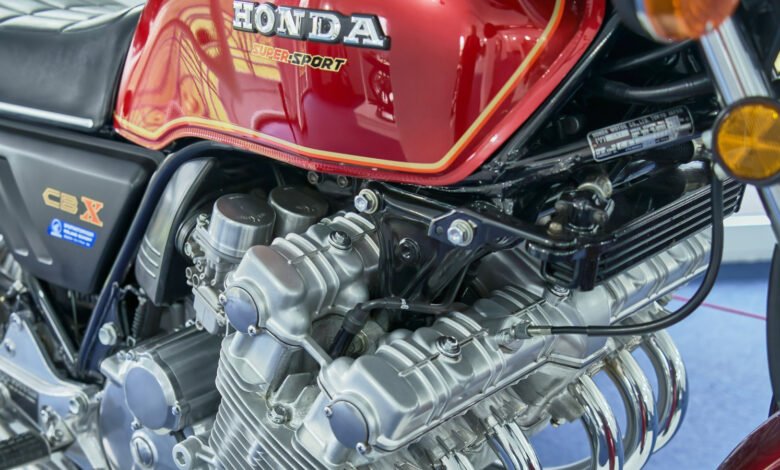
4. 1979 Honda CBX The Honda CBX was an engineering spectacle, its 1,047cc inline-six-cylinder engine serving as a breathtaking centerpiece. While its weight and handling were controversial, its straight-line performance was undeniable. The six-cylinder symphony powered the CBX to a top speed of around 140 mph, making it a unique and potent flagship.
3. 1977 BMW R100S Before the RS, the R100S was BMW’s performance champion. It shared the 980cc boxer engine but used a sleeker, half-fairing for reduced drag. In period tests, it consistently achieved top speeds between 125 and 130 mph, often outpacing more powerful Japanese rivals on long, fast straights thanks to its superior aerodynamics.
2. 1978 Kawasaki Z1R TC The Z1R TC represented Kawasaki pushing its own envelope. Starting with the potent Z1 engine, it added a factory turbocharger kit developed in partnership with Turbo Cycle Corporation. This forced induction system dramatically increased power output, enabling the bike to reach an astonishing 150 mph, making it the first production motorcycle to officially break that barrier.
1. 1972 Norton Commando Combat 750 Topping this list is the Norton Commando Combat 750. In a famous 1972 Cycle World test, a specially tuned example achieved a two-way average top speed of 151 mph. This astounding figure, reached by a 750cc parallel-twin, was a testament to Norton’s advanced engine tuning and the Isolastic frame system that effectively managed vibration. It remains one of the most impressive and unexpected speed records of the period.
(Source: jalopnik)