Rivian’s AI-Powered Self-Driving Strategy Revealed
▼ Summary
– Rivian’s “Autonomy & AI Day” showcased its new AI-based self-driving software, but a malfunctioning cafeteria robot highlighted the inherent difficulty of the technology.
– During a demo, Rivian’s 2025 R1S SUV using the new “Large Driving Model” performed adequately but required a human intervention and exhibited other minor disengagements.
– The company pivoted in 2021 to develop an end-to-end, AI-centric driving platform, abandoning its old rules-based system, and has recently seen rapid progress as data increased.
– Rivian plans a phased rollout, starting with “Universal Hands-Free” driving on mapped roads this month and aiming for “point-to-point” hands-off capability by late 2026.
– Future “eyes-off” autonomy depends on new hardware coming to the R2 SUV after its launch, creating a near-term challenge where early buyers will have a more constrained system.
A demonstration of Rivian’s new self-driving technology began with an unintentional metaphor. A small robot, not made by the company, became stuck in a Palo Alto office cafeteria, its screen flashing a helpless message. This minor hiccup underscored a central truth explored during the event: achieving reliable vehicle autonomy is an immensely difficult challenge. Hours later, during a brief ride in a prototype 2025 R1S, that reality was gently reinforced. The SUV, running what Rivian calls its “Large Driving Model,” navigated a winding route with general competence, handling stops and turns. Yet it also braked sharply for a slowing Tesla, prompting a near-intervention from the safety driver, and required human control to navigate a lane blocked by tree-trimming equipment. Other demo vehicles experienced similar moments. For software not yet ready for public release, especially after a fundamental strategic shift, the performance was a promising, if imperfect, start.
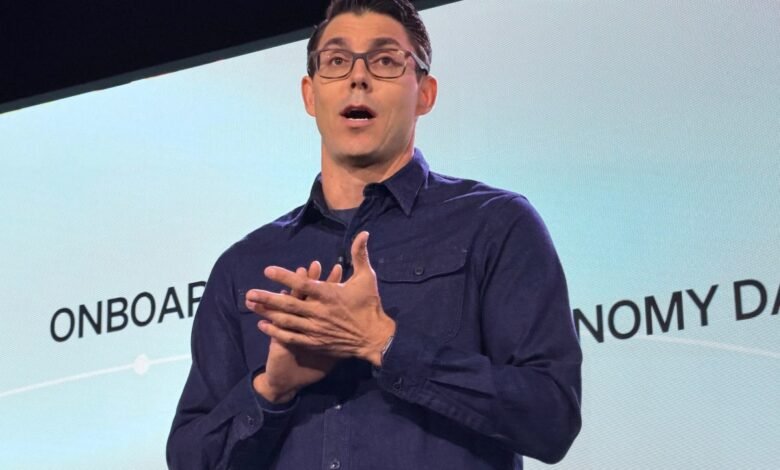
The company’s journey to this point involved a significant, quiet change in direction. In 2021, Rivian CEO RJ Scaringe made the pivotal decision to abandon a traditional, rules-based driver-assistance system. That older approach relied entirely on human-programmed instructions for every scenario. Inspired by the rise of transformer-based AI, Scaringe reconstituted the team to build a new, ground-up platform designed for an AI-centric world. After extensive development, this new software launched in 2024 on the second-generation R1 vehicles, which utilize Nvidia’s Orin processors. Scaringe notes that dramatic progress only became evident once real-world data from the fleet began flowing in to train the AI model.
Rivian’s ambitious bet is that this data-driven training will accelerate rapidly. The company plans to roll out its “Universal Hands-Free” feature later this month, allowing drivers on millions of miles of mapped roads in the U.S. and Canada to remove their hands from the wheel. A more advanced “point-to-point” driving capability, similar to the demo experience, is targeted for the latter half of 2026. The long-term roadmap aims for “eyes-off” driving, but this depends on new hardware. By late 2026, the upcoming, more affordable R2 SUV will launch with a new custom autonomy computer and a lidar sensor, which are essential for that next step. True, unsupervised autonomy remains a more distant goal.
This hardware timeline presents a near-term consideration for customers. The R2 will go on sale months before the new autonomy computer is ready. Early adopters will get the hands-free, point-to-point software but will need to wait for a hardware upgrade to achieve eyes-off capability. Scaringe acknowledges this potential for perceived obsolescence but emphasizes transparency, allowing customers to decide if they want the vehicle immediately or prefer to wait for the full suite of features. He stated that with strong pre-order demand for the R2, the company can be direct about the phased rollout.
The vision for Rivian’s autonomy has always extended beyond highways. Years ago, Scaringe described a goal where a vehicle could autonomously meet its owner at the end of a hiking trail. He maintains that such an adventure-focused use case is possible within the next few years, likely as the company approaches more advanced levels of autonomy. The AI model, once trained on unstructured environments, could handle dirt roads to a trailhead. However, he is quick to set boundaries: don’t expect a Rivian to robotically conquer extreme rock-crawling obstacles like Hell’s Gate in Moab. That particular adventure, for now, will still require a human at the wheel.
(Source: TechCrunch)