Rivian’s AI Assistant Arrives in EVs Early 2026
▼ Summary
– Rivian’s proprietary AI assistant will launch in early 2026 and be available to all existing Rivian EVs, not just new models.
– The assistant will control vehicle functions like climate and integrate with third-party apps, starting with Google Calendar.
– It will be augmented by Google’s Vertex AI and Gemini for data, natural conversation, and reasoning capabilities.
– The development is part of Rivian’s vertical integration push, which includes creating custom hardware like a 5nm processor for advanced driver assistance.
– The assistant is powered by Rivian Unified Intelligence (RUI), a hybrid software platform also designed for uses like vehicle diagnostics.
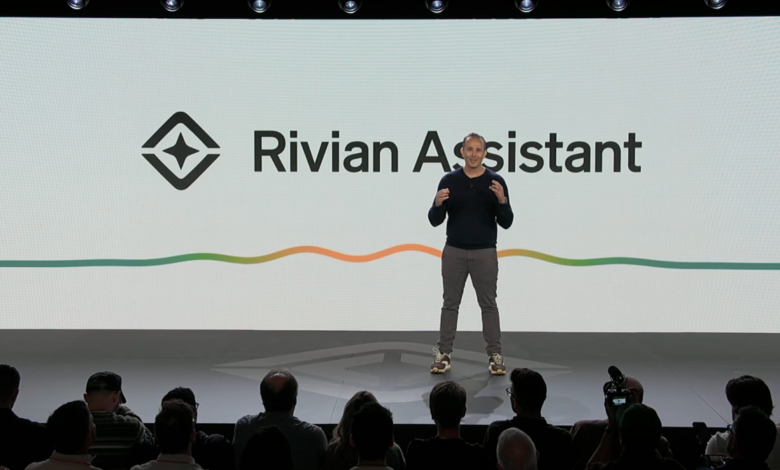
Rivian’s proprietary artificial intelligence assistant is scheduled for a widespread release in the first part of 2026. This new system will be made available to every existing Rivian electric vehicle, including current-generation R1T trucks and R1S SUVs, not just future models. The launch represents the culmination of a dedicated, two-year development effort by the automaker’s engineering teams.
The assistant will allow occupants to manage cabin climate and perform various tasks through the vehicle’s infotainment system using natural voice commands. A key feature is its ability to connect the vehicle’s own systems with external applications through a specialized agentic framework developed in-house. The first third-party integration will be with Google Calendar, enabling the assistant to manage scheduling and provide relevant reminders based on trip data.
During a recent event in Palo Alto focused on AI and autonomy, Rivian’s software development chief Wassym Bensaid emphasized the flexibility of this approach. He explained that the architecture allows for the seamless integration of various third-party agents, which fundamentally changes how applications will function within the automotive environment. To enhance its capabilities, the assistant will leverage Google’s Vertex AI and Gemini platforms for accessing grounded data, facilitating natural conversations, and performing complex reasoning tasks.
This initiative is a central part of CEO RJ Scaringe’s strategy for greater vertical integration. The company showcased this commitment extensively at its event, detailing not only the AI assistant but also new proprietary software and hardware. This includes a custom 5-nanometer processor developed with Arm and TSMC, designed to expand the capabilities of its hands-free driving assistance system with the eventual goal of allowing drivers to look away from the road.
Rivian’s push toward controlling more of its technology stack has been a multi-year process. Last year, the company undertook a comprehensive overhaul of its flagship vehicles, updating everything from the battery packs and suspension to the entire electrical architecture, sensor suite, and user interface software. Bensaid’s software team has been building out this foundational stack, while a separate, undisclosed group focused specifically on creating the AI assistant, which is designed to work across different vehicle models and platforms.
The technological backbone of this system is called Rivian Unified Intelligence (RUI). Described as a model and platform-agnostic architecture, RUI employs custom large language models and a hybrid software stack. This includes Rivian’s own models and a crucial “orchestration layer” that acts as a conductor, ensuring various AI models work together cohesively. The company has also utilized specialized agentic AI functions from other firms to complement its own development.
Bensaid described RUI as the essential connective tissue running through Rivian’s entire digital ecosystem. The platform is intended to enable targeted agent solutions that add value across all company operations and throughout the entire vehicle lifecycle. Its applications extend far beyond the in-car assistant. For example, RUI will also be deployed to enhance vehicle diagnostics, functioning as an expert tool for service technicians by analyzing vehicle telemetry and history data to accurately identify complex mechanical issues.
(Source: TechCrunch)