Rivian Develops Its Own AI Assistant for Vehicles
▼ Summary
– Rivian has been developing its own AI assistant for nearly two years, a project separate from its joint venture with Volkswagen.
– The company plans to share more details at its December 11 AI & Autonomy Day and has targeted releasing the assistant by year’s end.
– The assistant is a thoughtfully designed, integrated system for vehicle controls, built on a flexible, model-agnostic architecture using an agentic framework.
– It features a hybrid software stack combining edge and cloud AI, developed largely in-house with custom models and an orchestration layer.
– Rivian’s joint venture with Volkswagen focuses on electrical architecture and software, not on this AI assistant or automated driving technology.
Rivian has dedicated nearly two years to developing its own proprietary AI assistant for vehicles, a project that operates independently from its major software joint venture with Volkswagen. The electric vehicle maker has not yet announced a specific launch date for consumers, but the company’s software chief, Wassym Bensaid, indicated earlier this year that the target is for the end of this year. More details are expected to be revealed during Rivian’s upcoming AI & Autonomy Day, scheduled for a livestream on December 11.
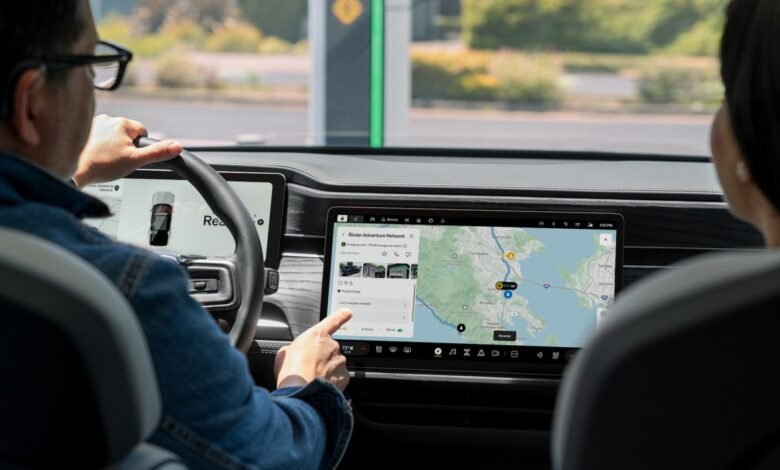
This initiative reflects the broader industry trend where automakers are racing to integrate advanced artificial intelligence. However, Bensaid emphasized that Rivian’s approach is not a hasty reaction to current trends. It is far more than a basic chatbot added to the infotainment screen. The company has invested significant thought, resources, and time into creating a product designed for deep integration with all vehicle controls.
The development began with a core philosophy: building an overall architecture that is agnostic to specific AI models and platforms. The team, based in Palo Alto, quickly recognized the need to focus on the software layers that coordinate various workflows and the control logic that resolves potential conflicts. “We use what the industry loves to now call an agentic framework,” Bensaid explained, noting that this architecture was planned from the start to interface with different AI models. This in-house platform represents a key part of Rivian’s broader strategy to increase vertical integration, following recent comprehensive overhauls of its R1T truck and R1S SUV that updated everything from the battery and electrical architecture to the software interface.
Substantial resources have also been directed toward Rivian’s proprietary software stack. This includes the real-time operating systems managing core vehicle functions like thermal dynamics and safety, as well as the layer for the infotainment system. While Bensaid did not share exhaustive details about the AI assistant, he described it as utilizing a mix of models for specific tasks. The system employs a hybrid software stack, blending edge AI for on-device processing with cloud AI for more computationally intensive models on remote servers. This split aims to create a flexible and customized assistant that efficiently distributes workloads.
Much of this AI software stack was developed internally, including custom models and a critical “orchestration layer” that acts as a conductor to ensure the various AI models work together seamlessly. For certain specialized agentic AI functions, Rivian collaborated with external partners. The overarching mission, according to Bensaid, is to build an AI assistant that enhances customer trust and engagement.
For the time being, this AI assistant project remains solely within Rivian. The company’s separate, multi-billion-dollar technology joint venture with Volkswagen, which officially began in late 2024, is focused on foundational electrical architecture, zonal computing, and infotainment, not on an AI assistant or automated driving systems. While autonomy and AI are separate endeavors now, Bensaid left the door open for future convergence, stating, “it doesn’t mean that it may not be in the future.”
(Source: TechCrunch)