Claude Code’s $1B in 6 Months: My AI App Proves Why
▼ Summary
– Anthropic’s Claude Code reached $1 billion in revenue just six months after its release, a remarkably fast adoption rate compared to previous major IT shifts.
– The tool’s key innovation is “agentic coding,” allowing it to autonomously perform complex series of programming tasks, a capability that emerged across major AI companies around May 2025.
– Claude Code’s early command-line accessibility gave it a significant adoption advantage over competitors who initially relied on web interfaces or specific IDE integrations.
– The author built a complex, fully-functional iPhone app with 365 features in 11 days using Claude Code, despite having no experience with the required Swift/SwiftUI language and framework.
– While a powerful productivity tool, Claude Code requires extensive management, testing, and patience, as it makes frequent mistakes and needs constant guidance from an experienced user.
The remarkable ascent of Claude Code to a $1 billion revenue milestone in just six months underscores a seismic shift in software development. This isn’t just another tool; it represents a fundamental change in how complex applications are built, moving from manual coding to AI-assisted creation. My own experience developing a sophisticated iPhone app from scratch in 11 days serves as a powerful testament to its transformative potential, proving that agentic coding capabilities are now a tangible reality for developers.
So, what exactly propelled Claude Code to such rapid success? From a personal standpoint, the tool generated 19,647 lines of code and 5,139 lines of documentation for my project, creating 63 user interface views and 114 source files. It accomplished this in under two weeks, working around my primary job. To understand its impact, we need to look at the broader market evolution.
Around May of 2025, a significant leap occurred. Companies like Anthropic, Microsoft, OpenAI, and Google all introduced what are termed “agentic” coding tools. The key difference from the previous generation of AI coding assistants is autonomy. These new systems can execute a series of tasks independently. You can instruct the AI to redesign a user interface or implement a complex backup system, and it will proceed to work on the code and report back.
Initially, tools like OpenAI’s Codex and Google’s Jules operated primarily through web interfaces tied to GitHub repositories. While functional, this approach made real-time testing and iterative development cumbersome. Microsoft’s GitHub Copilot took a different path by integrating its chat directly into the popular VS Code programming environment. Anthropic, however, made a strategic move by releasing Claude Code with command-line access from day one. This meant programmers could use it seamlessly within any terminal, issuing prompts just like any other command. This early focus on command-line ease of use appears to have been a major driver of its swift adoption among developers.
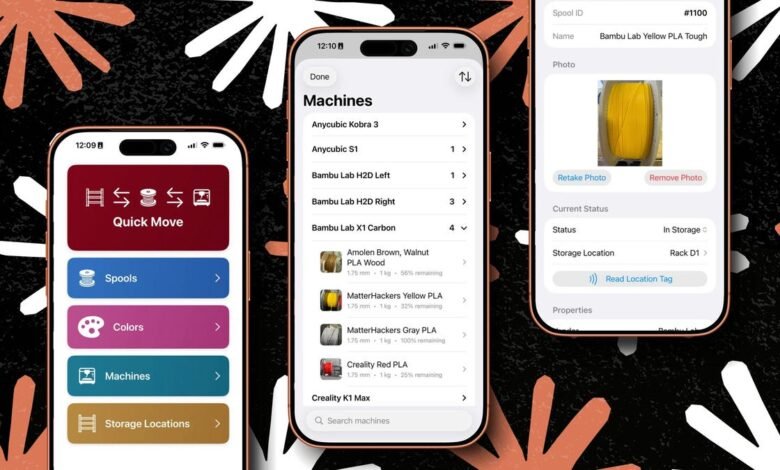
Intrigued by the buzz, I decided to put Claude Code to a serious test in mid-November. I needed an iPhone app to manage the inventory for my seven 3D printers and over 100 spools of filament. My previous method, voice notes and a manual database, was hopelessly inefficient. I envisioned an app that used NFC tags for seamless tracking.
My initial attempt using Claude Code within Apple’s Xcode development environment was a disaster, with constant crashes. The same issue occurred with other AI tools in Xcode. The breakthrough came when I switched to using Claude Code directly from the Mac’s Terminal app. The development process became fluid and productive.
It’s important to note that while I have programming experience, I had never used Apple’s modern Swift language or SwiftUI framework. I didn’t write a single line of code for the final application. Instead, I spent 11 days managing, directing, and testing the output from Claude Code. The resulting app is far from simple. It includes the ability to read and write NFC tags using the iPhone’s hardware, capture and import photos, perform rapid searches, sync data to iCloud across devices, create backups, analyze photos for color matching, and execute a “Quick Move” workflow for inventory management.
I deliberately started with the most technically challenging components: the proprietary Apple APIs for NFC and photo management, and iCloud syncing. If Claude Code could handle those, the rest would be straightforward. By the end of the first four-hour session, I had a functional prototype performing all three core complex tasks. This wasn’t magic, though. It required constant supervision. I had to guide the AI, clarify instructions, and often send it back to reattempt tasks dozens of times until they worked correctly. This process leveraged my years of product design and marketing skills more than traditional coding knowledge.
The app encompasses roughly 365 individual features across various modules. Given my typical development pace, building this alone in a unfamiliar language would have taken years. With Claude Code, I had a fully operational tool in 17 calendar days. While I plan to add features like spool retirement and expand to Mac and Apple Watch, the core app is already solving my real-world problem.
Claude Code operates on a usage-based subscription model. After quickly exhausting a lower tier, I moved to the $100 per month “Max” plan, which has proven sufficient. If the reported $1 billion revenue is spread across six months of $100 subscriptions, it suggests an adoption by approximately 1.6 million developers. That is an extraordinary rate of uptake for a professional tool.
The key takeaway is that Claude Code is an astonishing productivity multiplier, but it is not an autonomous app factory. It makes significant errors regularly and demands meticulous management, testing, and patience. A complete novice would struggle, but for someone with development or product experience, it dramatically accelerates creation. My functional, complex iPhone app stands as real evidence. This tool has moved beyond hype to become a practical engine for building software, fundamentally changing the developer workflow for those willing to learn how to guide it effectively.
(Source: ZDNET)