Survey: Social Media Drives More SMB Traffic Than SEO
▼ Summary
– Social media has surpassed organic search as the primary traffic driver for small and medium-sized businesses (SMBs), with 64% citing it as a main source.
– SMBs are increasingly monitoring AI-generated referrals and view competitors appearing in AI summaries as a significant emerging threat.
– Forty percent of SMBs report losing traffic due to Google updates and AI-driven search, with larger companies being the most affected.
– While AI search is not yet a top traffic driver, it offers smaller brands visibility by pulling content from sites beyond Google’s top results.
– To improve AI visibility, SMBs are focusing on core SEO fundamentals like clear headlines, readability, and technical website performance.
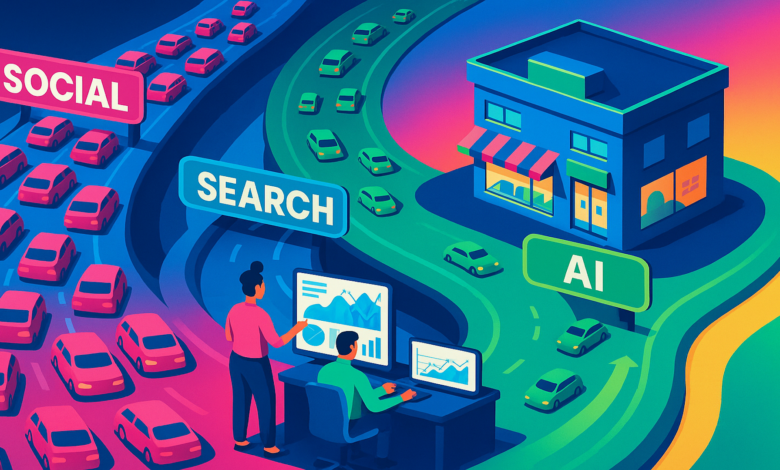
For many small and medium-sized businesses, the landscape of online customer acquisition is shifting. Social media platforms have now overtaken organic search as the primary source of website traffic, according to recent survey findings. This change highlights a significant evolution in how consumers discover products and services, with social channels becoming a more dominant force than traditional search engine results. At the same time, businesses are increasingly paying attention to a new frontier: traffic generated by artificial intelligence tools and summaries, which many see as both an opportunity and a competitive threat.
The data reveals a notable trend: forty percent of SMBs report losing traffic due to Google algorithm updates and the rise of AI-driven search experiences. Larger companies within this group felt the impact most acutely, with nearly half noting declines. Despite these challenges, a strong majority, 72%, still consider their overall SEO efforts to be effective. The ascendancy of social media is clear, with 64% of businesses naming it a key traffic driver, compared to 52% for organic search. This is especially true for solopreneurs and the smallest companies, who ranked social platforms first. Interestingly, 35% of businesses operating without a dedicated website stated that social media and online marketplaces generate sufficient leads, making a site unnecessary for now.
While AI search is not yet a top traffic source, it is firmly on the radar for business owners. Half of all SMBs surveyed are now monitoring their brand for AI-generated referrals and mentions, a figure that jumps to 70% among larger SMBs. There is also a growing awareness of Google’s Experimental (GEO) search features across companies of all sizes. A primary concern for many is the frustration of seeing competitors featured in AI summaries instead of their own business. However, an emerging silver lining exists: these AI models often source information from websites beyond Google’s typical top ten results, potentially offering smaller brands a valuable chance for visibility they might not otherwise achieve.
For businesses tracking AI referrals, certain core website pages prove most critical. The homepage is the most frequently cited entry point (57%), followed by product or service pages (48%) and contact pages (34%). In response to this new channel, SMBs are adapting strategies that closely mirror foundational SEO practices. The top actions include employing clear, descriptive headlines (35%), improving overall content readability (26%), and fixing basic technical issues like site speed and mobile performance (24%). Larger SMBs are taking additional steps, such as building external brand mentions (33%) and implementing structured data (30%) to enhance their presence in AI-driven environments.
The findings underscore a dynamic period for small business marketing. The dual forces of social media dominance and the nascent rise of AI search are reshaping priorities. Companies are learning that a diversified approach, honoring SEO fundamentals while aggressively engaging on social platforms and preparing for AI, is becoming essential for sustained online growth and customer reach.
(Source: Search Engine Land)


