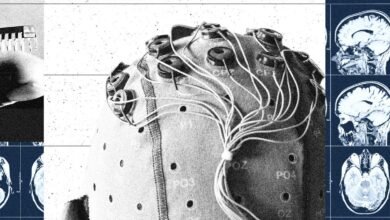
Paradromics Wins FDA Approval for Human Brain Implant Trial
▼ Summary
– Paradromics received FDA approval for early human trials of its brain implant designed to restore communication abilities in people with severe motor impairments.
– The trial will assess the device’s long-term safety and its effectiveness in enabling synthesized speech and text communication, beginning with two participants next year.
– Brain-computer interfaces like Paradromics’ device decode motor cortex signals generated when attempting to speak, rather than reading inner thoughts directly.
– The Connexus implant uses 421 microwire electrodes to record neural activity and aims to achieve communication speeds of 60 words per minute, with plans to use AI for voice cloning.
– Paradromics is part of a competitive field including Neuralink, which has implanted its quarter-sized device with over 1,000 electrodes in at least 12 people worldwide.
A major step forward in neurotechnology has been achieved with Paradromics receiving FDA approval to begin human trials for its innovative brain-computer interface. The Austin-based neurotech firm announced this regulatory milestone, clearing the path for initial testing of its implant designed to restore communication abilities. This development represents significant progress in creating digital speech solutions for individuals experiencing severe paralysis or other conditions that prevent verbal communication.
The upcoming clinical study will primarily evaluate the long-term safety profile of the Paradromics system while simultaneously measuring its effectiveness in generating synthesized speech and text output. This positions Paradromics among a growing field of neurotechnology pioneers including Neuralink, Synchron, Precision Neuroscience, and Cognixion, all developing systems that translate neural activity into digital commands. These brain-computer interfaces function by detecting electrical patterns in the brain’s motor cortex that occur when a person intends to move or speak, then converting those signals into actionable outputs.
Human testing is scheduled to commence early next year with an initial cohort of two participants. Following a six-month data collection period from these first volunteers, the company intends to petition the FDA for authorization to broaden the study to include additional subjects. Matt Angle, Paradromics’ Chief Executive and founder, expressed optimism about the potential communication speeds, noting that previous academic BCI research has demonstrated rates approaching 60 words per minute. While this falls short of typical conversational speeds of 120-150 words per minute, it would represent a dramatic improvement for those currently unable to communicate.
These advanced systems do not interpret private thoughts or internal monologues. Instead, they specifically decode neural signals generated when users attempt physical speech movements. Participants will be instructed to mentally articulate words and sentences, enabling the system to learn the unique neural patterns associated with their speech attempts. The translated text will then appear on a display almost instantaneously. Angle further explained that with existing voice recordings, the technology can generate synthetic speech that closely mimics the participant’s natural voice using artificial intelligence.
Earlier this year, Paradromics conducted a brief preliminary implantation during an unrelated neurosurgical procedure. Medical professionals used a specialized delivery device, comparable to an EpiPen injector, to temporarily place and remove the neural interface. This ten-minute procedure served as a technical validation without attempting speech restoration. The forthcoming trials will involve long-term implantation of the company’s Connexus device.
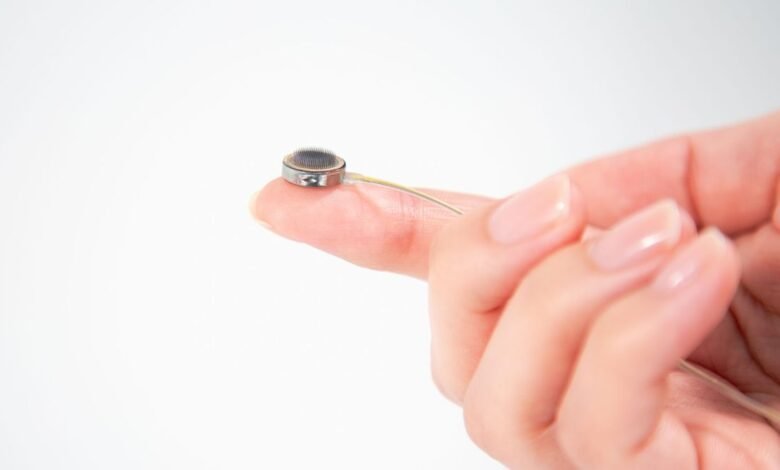
The Connexus implant features a compact metallic disc, smaller than a dime, embedded with 421 microscopic wire electrodes that interface directly with brain tissue to record neuronal activity. This design differs notably from Neuralink’s quarter-sized skull-embedded chip, which utilizes over 1,000 electrodes distributed across 64 ultra-fine threads implanted by a custom robotic system. Neuralink has reportedly implanted its technology in at least twelve patients globally, marking accelerated progress in the commercial BCI sector.
(Source: Wired)