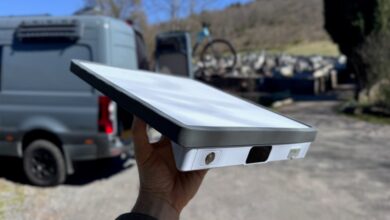
Exploring Rome’s Art with Meta Ray-Ban Smart Glasses

▼ Summary
– The author tested Meta Ray-Ban smart glasses during solo travel in Italy, particularly at the Vatican Museum where their audio guide failed.
– While the glasses’ live translation feature performed poorly in crowded tourist areas, they proved useful for discreet photography and receiving navigation directions.
– The glasses worked best for specific, limited-time purposes like tourism rather than as all-day replacement devices due to battery and comfort limitations.
– Using the glasses primarily in “Tourist Mode” alleviated the author’s privacy concerns that had surfaced during daily use back home.
– The author suggests smart glasses might be more successful as niche rental devices for specific activities rather than general-purpose smartphone replacements.
Anyone who loves art knows a trip to Rome isn’t complete without seeing the Sistine Chapel. What they might not realize is that the journey through the Vatican Museum to get there can feel longer than an epic quest through Middle-earth. You might imagine a prepared visitor would have a knowledgeable guide or at least a functioning audio tour for the two to three hour stroll past endless marble sculptures and ancient pottery. I, however, was not that prepared. My family booked our tickets at the last possible moment, leaving me to tackle a solo, self-guided tour during one of the final time slots of the day.
My only resources were a pair of Meta Ray-Ban Smart Glasses, an international data plan from T-Mobile, and an iPhone with a battery hovering dangerously close to zero. To my genuine surprise, I ended up having a fantastic experience.
I landed in Italy twenty-five days earlier feeling completely drained. Vacation had officially started, work was finished, bags were packed, and the cat was cared for. I should have been relaxed, but instead I spent the eight-hour flight to Rome preoccupied with my recently published review of the Meta Ray-Ban Smart Glasses and the minor existential crisis it prompted.
The glasses themselves are a marvel of engineering. My review had grappled with the privacy concerns and cultural questions they raise in daily life, while also acknowledging the real opportunities this technology presents. I was particularly curious to test the live translation feature. The moment I landed, I put the glasses on.
Ironically, the live translation feature proved disappointing, which is why I didn’t cover it in last week’s newsletter. It might work fine in a quiet, one-on-one conversation, but that’s a rarity in crowded tourist spots. There’s always background chatter, garbled public announcements, and the fact that experienced retail and hospitality workers often take one look at my very non-Italian face, offer a quick “buongiorno,” and immediately switch to English.
So, my expectations were low when my phone’s audio guide died just ten minutes into my trek toward the Sistine Chapel. Let’s be honest, after you’ve seen one classical marble statue, do you really need a detailed explanation for the next twenty nearly identical ones you’ll pass over the next 1.86 miles? Still, Meta had specifically highlighted using their AI glasses to provide context for art during my demo. This was a perfect, unscripted chance to test that claim far from the controlled environment of a corporate presentation.
The performance wasn’t flawless. When I paused at a particular marble bust in an area with a faint LTE signal, Meta AI identified it as the Belvedere Torso. My connection dropped before it could offer any further details. Even so, I felt a wave of relief from the frustration of navigating the museum’s confusing layout. It struck me that if the Vatican ever installed robust Wi-Fi, which it likely won’t for security reasons, this could evolve into a far less cumbersome alternative to traditional audio guides.
When my sister-in-law texted to ask if I was getting close (her tour group had left a full thirty minutes before I was even admitted), I appreciated being able to see her message, look up, take a photo of the frescoed ceiling with my glasses, and send a reply. It took three attempts for the message to go through, but fifteen minutes later her response arrived: “Oh, you’re not close at all.”
The real enjoyment came from recording short videos and narrating my experience to send to a friend back home. Yes, I was muttering to myself and earning the occasional strange look. But the significant upside was that my phone stayed in my bag. I wasn’t viewing all this magnificent Art with a capital A through a tiny screen, unlike nearly every other tourist standing between me and Michelangelo’s masterwork.
When I finally reached the Sistine Chapel, a guard immediately yelled at me as I tried to use my phone’s camera to zoom in on the details. He pointed to a sign I’d missed: phones and photography are strictly forbidden inside the chapel. Fair enough. What he didn’t notice were the smart glasses on my face. Tilting my head back, I spent a full ten minutes using the glasses to zoom in and count as many expertly painted cherub backsides as I could find. It might seem silly to travel across an ocean and navigate a human maze just for that, but Michelangelo was my mom’s favorite artist. When I was a kid acting up in museums, we’d play a game counting Renaissance-era rears, something I’d rather perish than explain to an irritable guard.
Part of me felt guilty for engaging in the very “glasshole” behavior I’d worried about in my review. The other part just laughed, blaming the jet lag and, honestly, the inherent humor in angelic derrieres. When it was time to leave, I felt perfectly content to take the glasses off.
This Sistine Chapel experiment, for all its flaws, was a revelation. While the technology has advanced tremendously, smart glasses often don’t feel practical for all-day, everyday use. The battery life is too short, and the frames can feel too large, heavy, and clunky. However, these shortcomings matter far less when you wear them for a specific, limited purpose.
During my daily commute in New York City, I feel uncomfortable recording video or taking photos with them. The city’s logical grid system also makes augmented reality walking directions largely unnecessary. In my neighborhood or during my usual routines, I rarely have a question I feel compelled to ask a virtual assistant. But in Italy, where I was constantly lost and crossing the street felt like a real-life game of Frogger, those heads-up walking directions were transformative. And once I reached my destination, the glasses went straight back into their charging case.
Later, on a tour of the Pompeii ruins, the glasses proved useful again. Being able to take a photo with a simple finger tap was far less disruptive than pulling out a phone. Sure, I sometimes needed my phone to perfectly capture the essence of a wandering cat, but I noticed that every time I took my phone out, I’d fall behind the group. Once the tour concluded, I took the glasses off and immediately felt unburdened.
The crucial element was the freedom to put them away.
In Italy, I reserved the glasses for what I called “Tourist Mode” and for use in public spaces. This felt far more natural and less intrusive than incorporating them into my daily life. Companies like Meta often market these devices as general-purpose tools destined to replace your phone. Perhaps one day that will be true. For now, I’m struck by how my cultural reservations faded when I tied the glasses to a temporary, specific use case. In Italy, putting them on meant entering Tourist Mode. Taking them off meant returning to my normal self. The imperfections were tolerable precisely because the glasses were just one tool among many in my travel kit.
Now that I’m home, I feel a subtle pressure to use the glasses whether it makes sense or not, partly for work, and partly due to the nagging thought of why own them if I’m not trying to replace my phone.
But what if these devices weren’t forced to inherit the smartphone’s mantle as a general-purpose, mass-market gadget? What if we allowed them to be specific, niche tools, ‘sometimes’ devices that you might even rent instead of own? Imagine renting “Tourist Smart Glasses” from a travel agency before a big trip, or your employer providing a pair for job-specific tasks. Stadiums and concert venues could offer them for rent during events. Theaters and opera houses might use them to display subtitles for foreign-language performances. When you’re done, you’d simply return to using your phone.
Naturally, this approach comes with its own set of challenges. Long before Meta’s current consumer push for AI glasses, other smart glasses makers pivoted to enterprise solutions after Google Glass’s very public failure. We operate in a system of late-stage capitalism, and a rental or niche model is arguably a more complicated, logistically difficult path to profitability. Some of these use cases have been attempted before, with issues like high cost, lack of long-term user commitment, pricing, and bulky hardware preventing widespread adoption. Even if smart glasses were confined to specific scenarios, it would only take one tech-savvy individual acting inappropriately to reignite the debates about privacy and obnoxious user behavior.
Still, my most positive experience with smart glasses occurred precisely when they weren’t expected to be a “do everything” device. That distinction made all the difference.
(Source: The Verge)