Mars: How Wind Transformed the Red Planet into a Dust World
▼ Summary
– Mars experiences powerful winds that create dust devils and large dust storms, significantly impacting its environment.
– Researcher Valentin Bickel used stereo images from Mars orbiters and deep learning to analyze wind patterns and dust movement.
– The study revealed that Martian winds are faster and carry more dust than previously estimated by earlier observations.
– Dust on Mars influences atmospheric processes, causing temperature changes and triggering massive dust storms.
– Martian dust may have affected the planet’s potential for life by transporting nutrients and providing radiation protection.
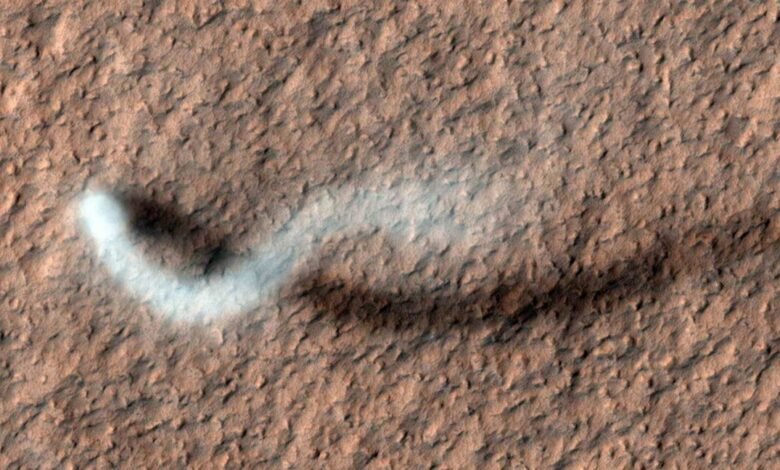
Understanding the powerful forces that shape Mars is key to unraveling the planet’s history and current conditions. Mars is a world dominated by wind and dust, where relentless gusts lift immense quantities of fine, reddish particles into the thin atmosphere. These winds generate swirling dust devils and can escalate into planet-wide dust storms that last for days, fundamentally influencing the Martian environment.
Driven by curiosity about the true intensity of these winds, researcher Valentin Bickel led an investigation using advanced imaging technology. His team utilized data from the CaSSIS camera on the ExoMars Trace Gas Orbiter and the HRSC camera aboard the Mars Express orbiter. By applying deep learning algorithms to analyze stereo images captured moments apart at identical locations, they could precisely track the movement of dust devils. This method allowed them to deduce the speed and behavior of the underlying winds responsible for lifting vast amounts of surface material.
Bickel, who is affiliated with the Center for Space and Habitability at the University of Bern, discovered that Martian winds are significantly faster and carry far more dust than earlier estimates suggested. The research, detailed in a recent issue of Science Advances, concludes that strong near-surface winds are abundant on Mars and play an important role in atmospheric dust sourcing. These findings are crucial for developing more accurate models of the Martian atmosphere, weather patterns, and long-term climate.
The pervasive dust on Mars exerts a profound influence on both surface features and atmospheric processes. Airborne particles can trigger temperature fluctuations and alter atmospheric dynamics in ways that may initiate massive dust storms. When this dust eventually settles back to the ground, it can reshape surface characteristics, including the mysterious dark streaks observed on Martian slopes. While the question of past life on Mars remains unanswered, this ubiquitous dust may have played a role in planetary habitability by distributing nutrients across the landscape and potentially providing a protective layer against harsh solar radiation.
(Source: Ars Technica)