Lenovo’s Smart Glasses: Ultra-Light Design, But There’s a Catch
▼ Summary
– Meta’s Ray-Ban smart glasses incorporate AI and a camera, but Lenovo’s new V1 model challenges this approach by omitting the camera entirely.
– Lenovo’s V1 smart glasses weigh only 38g, making them significantly lighter than Meta’s models, which is a critical advantage for wearable comfort.
– The absence of a camera in the V1 limits its use for hands-free video capture and computer vision features, which may deter some potential users.
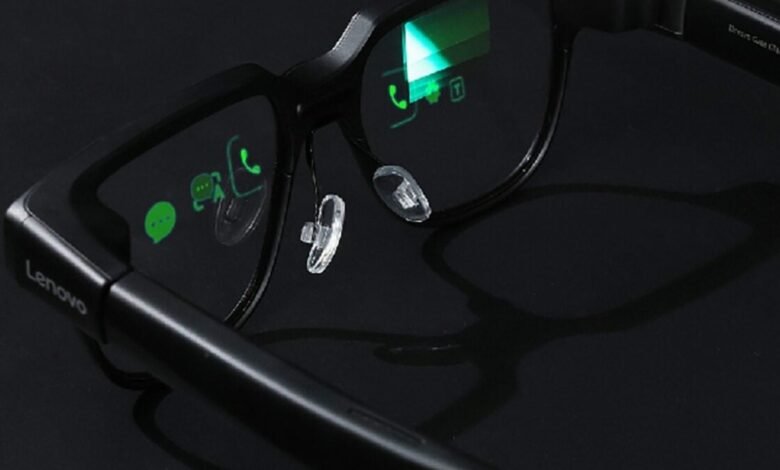
– Lenovo integrates AI through a voice assistant that supports real-time translation and voice commands, and the glasses feature a monochrome micro LED display with 2,000 nits brightness.
– Smart glasses manufacturers are still experimenting with features, balancing trade-offs like weight and privacy against functionality, as seen in Lenovo’s market-focused release in China.
While Meta has established a strong presence in the smart glasses arena, its approach of integrating cameras isn’t the only path forward. Lenovo’s new V1 smart glasses demonstrate a different philosophy, prioritizing an exceptionally lightweight build and a functional micro LED display while deliberately omitting a camera. This design choice creates a distinct product that appeals to users focused on screen-based utility and comfort rather than visual capture or computer vision features.
Weighing a mere 38 grams, the V1 model is significantly lighter than competing offerings. It undercuts the Ray-Ban Meta AI glasses by 10 to 14 grams and is roughly 30 grams lighter than the Meta Ray-Ban Display model. Although a difference of 10 grams might sound negligible on paper, it becomes far more noticeable when the device rests on your face all day. The absence of a camera is a primary factor enabling this featherlight construction.
However, the lack of a built-in camera represents a significant trade-off. For individuals who want to record their cycling adventures or document daily activities hands-free, the V1 will not meet their needs. Similarly, those excited by the computer vision capabilities found in Meta’s glasses, such as real-time text translation or object identification, will find these functions completely absent here. This makes the V1 unsuitable for anyone whose primary interest lies in visual AI interactions.
On the other hand, many potential users may not view the missing camera as a drawback. Other manufacturers, like Even Realities, have made the same design decision to reduce weight and directly address privacy concerns associated with wearable recording devices. For these consumers, smart glasses are primarily about the viewing experience, not capturing the world around them. In that regard, Lenovo’s offering is quite compelling. The monochrome micro LED display delivers a claimed brightness of 2,000 nits. While this doesn’t reach the peak brightness of the Meta Ray-Ban Display, it is more than sufficient for clear visibility in various lighting conditions. The display can be used in either monocular or binocular mode, providing flexibility for different applications.
It’s important to note that no camera does not mean no artificial intelligence. Lenovo has integrated its own voice assistant into the V1, enabling features like real-time translation, executing voice commands, and answering queries. A useful teleprompter mode is also included, allowing the wearer to display notes or scripts directly in their line of sight, a feature shared with products like Rokid’s glasses, ideal for presentations.
Ultimately, the Lenovo V1 serves as a clear indicator that the smart glasses market is still defining itself. Manufacturers are actively experimenting to determine which features consumers truly value and whether a sleek, lightweight form factor can triumph over a more comprehensive, but heavier, set of functions. For those eager to try this specific approach, the V1 glasses are available for pre-order at approximately $560, with an official launch set for November 9th. The initial release appears to be targeted mainly at the Chinese market.
(Source: Gizmodo)