Gartner’s Top Tech Trends Shaping 2026

▼ Summary
– Gartner identifies AI security platforms as essential for protecting AI applications through centralized visibility and guardrails against specific risks like prompt injection.
– Preemptive cybersecurity is shifting from reactive to proactive protection using AI-powered tools, with half of security spending expected to be preemptive by 2030.
– Confidential computing secures sensitive data by isolating workloads in hardware-based environments, crucial for compliance and collaboration in untrusted infrastructure.
– Physical AI integrates intelligence into real-world devices like robots and drones, driving automation gains but requiring new skills and change management.
– Digital provenance tools verify the origin and integrity of digital assets, with inadequate investment risking significant sanctions by 2029.
Businesses preparing for 2026 should pay close attention to several transformative technology trends identified by Gartner, which highlight the growing influence of artificial intelligence, cybersecurity, and data governance. These developments promise to redefine competitive landscapes and operational models across industries. According to Tori Paulman, a Vice President Analyst at Gartner, the pace of innovation has accelerated dramatically, creating a critical window for organizations to adapt and lead.
AI security platforms are emerging as essential tools for managing the risks associated with artificial intelligence. They offer a centralized approach to safeguarding both third-party and custom AI applications, addressing threats like prompt injection, data leaks, and unauthorized agent behavior. By 2028, more than half of all enterprises are expected to rely on these platforms to protect their AI systems and enforce consistent governance.
Preemptive cybersecurity represents a major shift from reactive defense to proactive threat prevention. As digital risks multiply, organizations are turning to AI-enhanced security operations and deception technologies to anticipate and neutralize attacks before they cause harm. Gartner forecasts that by 2030, half of all security budgets will be allocated to preemptive solutions.
Confidential computing introduces a new layer of data protection by running workloads in hardware-secured enclaves, shielding sensitive information even from cloud providers or hardware administrators. This approach is especially valuable in regulated sectors and for cross-border collaborations. It is projected that by 2029, confidential computing will secure over 75% of operations conducted in untrusted environments.
Physical AI integrates intelligence into real-world machinery, such as robots, drones, and industrial equipment, enabling them to perceive, decide, and act autonomously. This trend supports automation and safety improvements but also demands new skill sets that merge IT, operations, and engineering disciplines.
Digital provenance has become a priority as companies depend more on external software, open-source components, and AI-generated content. Tools like software bills of materials and digital watermarking help verify the origin and integrity of digital assets. Organizations that neglect these capabilities could face regulatory penalties reaching billions of dollars by 2029.
AI supercomputing platforms combine diverse processors, including CPUs, GPUs, and specialized AI chips, to handle complex computational tasks with unprecedented speed and efficiency. By 2028, more than 40% of top enterprises are expected to integrate hybrid computing architectures into core workflows, accelerating innovation in areas like drug discovery, financial modeling, and climate simulation.
Multiagent systems use groups of AI agents working together to automate intricate processes and support human teams. These modular systems improve efficiency, reduce risks, and help organizations scale operations more flexibly.
Domain-specific language models (DSLMs) address the limitations of general-purpose AI by training on specialized data for particular industries or functions. They deliver greater accuracy, lower costs, and improved regulatory alignment. Over half of the generative AI models used in enterprises are predicted to be domain-specific by 2028.
AI-native development platforms empower software engineers and domain experts to build applications more rapidly using generative AI. These tools enable smaller, more agile teams to produce secure, governed software with fewer resources. By 2030, 80% of organizations are expected to restructure their engineering teams around these AI-augmented platforms.
Geopatriation reflects a growing movement to relocate data and applications from global public clouds to sovereign or regional alternatives, driven by geopolitical concerns. This shift offers greater control over data residency and compliance. In Europe and the Middle East, adoption is projected to surge from under 5% in 2025 to over 75% by 2030.
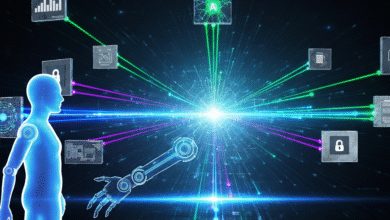
![Image: A visual representation of interconnected digital networks and AI systems]
Each of these trends underscores the need for strategic investment and organizational agility. Companies that embrace these technologies early will be better positioned to navigate future challenges and capitalize on new opportunities.
(Source: HelpNet Security)