The AGI Dream: Why LLMs Aren’t the Answer
▼ Summary
– Recent months have seen major setbacks for LLMs, with multiple developments challenging their path to AGI.
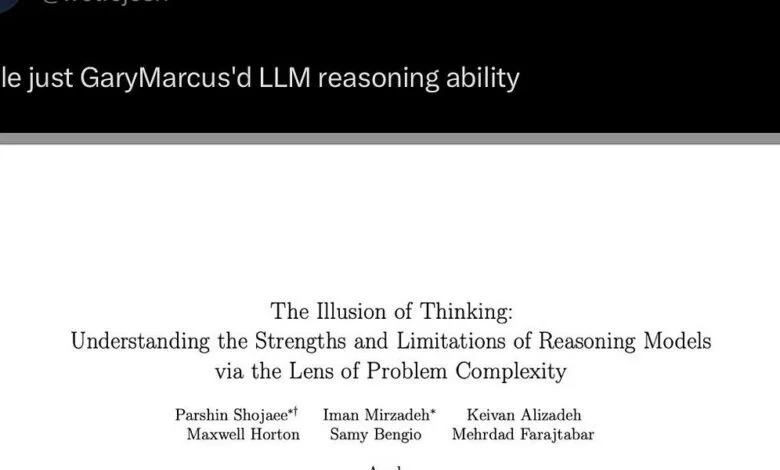
– The Apple reasoning paper and other studies confirmed LLMs’ inability to solve distribution shift, a core neural network weakness.
– GPT-5’s delayed release underperformed expectations, and experts like Andrej Karpathy stated AGI is at least a decade away.
– Prominent figures including Turing Award winner Rich Sutton and Nobel Laureate Demis Hassabis have critiqued overhyped LLM claims.
– The author emphasizes that LLMs have limitations and advocates for alternative AI strategies, referencing his earlier prescient warnings.
The initial excitement surrounding large language models as a direct pathway to artificial general intelligence has significantly diminished, with recent developments exposing fundamental limitations in this approach. The core issue lies in their inability to handle distribution shift, a critical weakness in neural network architectures that prevents true reasoning and adaptation. Several key events over recent months have starkly illustrated this reality.
In June 2025, research from Apple demonstrated that even enhanced “reasoning” capabilities failed to overcome distribution shift problems. This finding was rapidly corroborated by additional studies, including the influential “Mirage” paper from Arizona State University, reinforcing long-standing critiques about neural networks’ structural constraints.
The much-anticipated release of GPT-5 in August 2025 arrived behind schedule and failed to deliver the breakthrough many had hoped for. The model’s performance, while impressive in specific domains, fell considerably short of demonstrating genuine general intelligence or meaningful progress toward AGI.
September brought what many considered a seismic shift in the AI community’s perspective. Turing Award recipient Rich Sutton, renowned for his work in reinforcement learning and his famous “bitter lesson” argument, publicly acknowledged the validity of critiques against LLMs as a path to AGI. His endorsement represented a significant moment of consensus among leading researchers about the limitations of current approaches.
October witnessed two additional major developments that further dampened AGI optimism. Andrej Karpathy, the highly respected machine learning expert who previously led AI at Tesla and served two terms at OpenAI, stated unequivocally that AI agents remain far from achieving human-level capabilities. He estimated that AGI remains approximately a decade away from realization.
Simultaneously, Nobel Laureate and Google DeepMind’s Sir Demis Hassabis challenged what he characterized as exaggerated claims from OpenAI’s Sebastien Bubeck regarding mathematical capabilities. The technical analysis provided by Researcher and Hyperbolic Labs CTO Yuchen Jin highlighted significant gaps between promotional rhetoric and actual performance.
While large language models undoubtedly serve valuable purposes in specific applications, expecting the current architectural paradigm to deliver artificial general intelligence represents a fundamental misunderstanding of what AGI requires. The limitations now becoming apparent were predicted years in advance by researchers who advocated for alternative approaches combining symbolic reasoning with neural networks.
The evolving understanding of AI’s trajectory suggests that future progress will likely require hybrid architectures rather than relying exclusively on scaling existing language model technology. This perspective, once considered controversial within mainstream AI circles, has gained substantial credibility as the limitations of pure neural network approaches become increasingly evident through both theoretical analysis and practical demonstration.
(Source: Gary Marcus)