Scientists Build Living Computers from Human Cells
▼ Summary
– Swiss scientists are growing mini human brains called organoids from stem cells to create biocomputers that could use less energy than current AI systems.
– These organoids are attached to electrodes to send and receive electrical signals, allowing researchers to test basic commands and aim to trigger learning in the neurons.
– A major challenge is keeping the organoids alive long-term, as they lack blood vessels and currently survive only up to four months before dying.
– Biocomputing is being developed by multiple groups worldwide for applications like playing games and studying neurological diseases, but it’s seen as complementary to silicon-based AI, not a replacement.
– The concept draws from science fiction and raises philosophical questions about using neurons as machines, with researchers acknowledging the technology is still in early stages.
Researchers in Switzerland are pioneering a radical new form of computing by constructing biocomputers from lab-grown human brain cells. This emerging field, known as biocomputing, aims to develop data centers with “living” servers that could one day replicate aspects of artificial intelligence learning while consuming drastically less energy than conventional silicon-based systems.
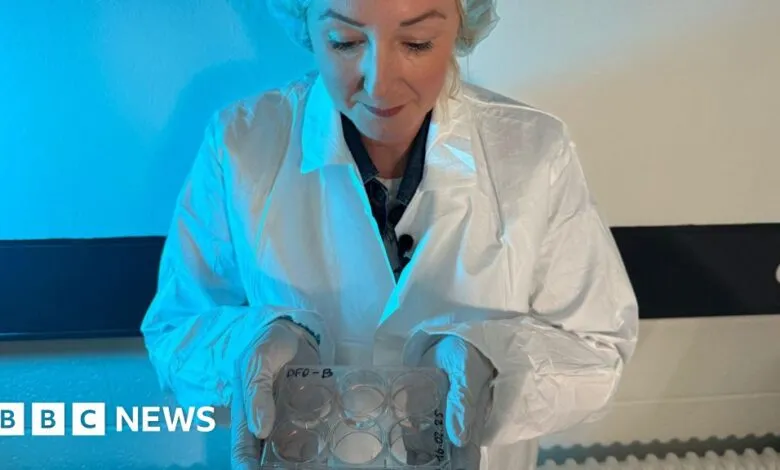
Dr. Fred Jordan, co-founder of the FinalSpark laboratory, envisions a future where biological components, or “wetware,” serve as the foundation for advanced computational tasks. The process starts with anonymous human skin cells acquired from regulated suppliers. These cells are reprogrammed into stem cells, which scientists then culture into three-dimensional clusters of neurons and support cells called organoids. While far simpler than a full human brain, these miniature structures share its fundamental biological building blocks.
After a maturation period lasting several months, the organoids are connected to electrodes. Researchers can then send electrical signals—triggered by simple keyboard commands—and monitor the neural responses on a connected computer screen. The activity appears as a moving graph resembling an electroencephalogram (EEG) readout. Dr. Jordan notes that responses are not always consistent, and the organoids sometimes exhibit unexpected bursts of energy or cease responding altogether, highlighting how much remains unknown about their internal processes.
A significant hurdle for biocomputing is sustaining the organoids’ viability. Unlike traditional computers that only require electricity, biological systems need constant nourishment. Professor Simon Schultz of Imperial College London points out that organoids lack blood vessels, which in a living brain deliver essential nutrients. This limitation currently restricts their operational lifespan; FinalSpark has managed to keep organoids functional for up to four months. Interestingly, the team has observed a curious phenomenon where some organoids display a sudden surge in activity just before dying, reminiscent of terminal lucidity observed in some human patients.
The potential applications of this technology extend beyond energy-efficient computing. Other groups are also exploring the possibilities: Cortical Labs in Australia taught neuron-based systems to play the classic game Pong, while researchers at Johns Hopkins University are developing mini-brains to model neurological disorders like Alzheimer’s and autism, potentially accelerating drug discovery and reducing reliance on animal testing.
Dr. Lena Smirnova from Johns Hopkins believes biocomputing will complement rather than replace silicon-based AI, creating new opportunities in specialized domains. Professor Schultz concurs, predicting that biological computers will find their niche rather than outcompeting conventional electronics across the board.
For Dr. Jordan, working at this scientific frontier feels like stepping into the pages of science fiction. He reflects that what was once imaginative speculation is now becoming tangible reality in his laboratory, where he and his team are actively writing the next chapter of computational science.
(Source: BBC)